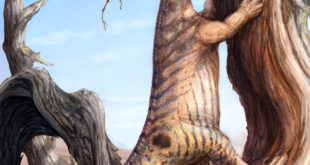
Sauropods are a group of plant-eating dinosaurs which exceeded all other terrestrial vertebrates in body size. A new, in-depth anatomical description of the best preserved specimens of Sarahsaurus aurifontanalis, a sauropod relative from North America, could help paleontologists with unraveling the mystery of why these dinosaurs got so big. Life …
Read More »Researchers Develop Contact Lenses that Change Color as Drugs Released
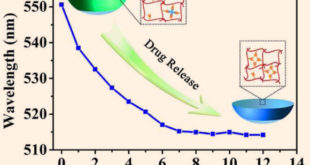
A team of researchers in China has developed drug-delivering contact lenses that could self-report the drug release process by color change. The team’s work appears in the journal ACS Applied Materials Interfaces. Color-changing contact lenses could help doctors determine whether drugs are being delivered to the intended treatment site. Image …
Read More »Study: Chimps Share Food with Friends
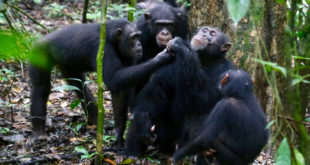
Why share when access to benefits is uncertain is crucial to our understanding of the evolution of cooperation in human societies. In a study published in the Proceedings of the Royal Society B, Dr. Catherine Crockford of the Max Planck Institute for Evolutionary Anthropology and colleagues investigated some of the …
Read More »New Study Reveals Link between Gut Microbiota and Multiple Sclerosis
Multiple sclerosis is an immune-mediated autoimmune disease of the central nervous system that develops in genetically susceptible individuals and requires environmental triggers. A new study, published in the journal Science Translational Medicine, shows that gut microbiota could play a big role in the pathogenesis of this disease. Under a high …
Read More »Lavender Genome Sequenced
A team of scientists from Brock University and the University of British Columbia, Canada, has sequenced the genome of the English lavender (Lavandula angustifolia), an economically important plant widely grown around the world. The English lavender (Lavandula angustifolia). Image credit: Rebekka D. The lavenders comprise the genus Lavandula, with over …
Read More »Dinosaurs May Be to Blame for Human Sunburns
Basking in the sun can be a great way to spend an afternoon while replenishing your vitamin D. However, too much time in the sun can lead to a nasty sunburn and an increased risk of skin cancer. Why are we so vulnerable to sunlight when it’s all around us? …
Read More »NASA’s Chandra X-ray Observatory Goes Offline Just a Week After Hubble
This last week has been a rough one for space news, to say the least. The iconic Hubble Space Telescope has been placed in safe mode following a hardware failure, and a Soyuz booster failure resulted caused NASA Nick Hague and cosmonaut Aleksey Ovchinin to abort their trip to the …
Read More »Planetary Researchers Find Evidence of Ancient Strike-Slip Tectonics on Ganymede
A new study, published in the journal Icarus, reveals Ganymede — the largest and most massive moon of Jupiter and in the Solar System — appears to have undergone complex periods of geologic activity, specifically strike-slip tectonism, as is seen in the San Andreas Fault on Earth. Ganymede, larger than …
Read More »Asteroid Lander MASCOT Completes Exploration of Ryugu
The Mobile Asteroid Surface Scout (MASCOT), a lander carried by JAXA’s Hayabusa-2 spacecraft, successfully completed its historic exploration of the near-Earth asteroid Ryugu on October 3, 2018, as its battery ran out. An artist’s impression of MASCOT during landing. Image credit: DLR. MASCOT was developed by the German Aerospace Center …
Read More »NASA Report Blames Boeing Mismanagement for SLS Delays
NASA has been without its own launch vehicle since the retirement of the Space Shuttle in 2011. Since then, the agency has been moving full-speed ahead with the Space Launch System (SLS). Well, it’s been trying. Delays and cost overruns have plagued the SLS, and a new report lays the …
Read More »
#Bizwhiznetwork.com Innovation ΛI |Technology News