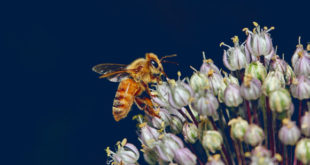
The total solar eclipse of 21 August 2017 traversed 5,000 km from coast to coast of North America. In its 90-min span, sunlight dropped by three orders of magnitude and temperature by 10-15 degrees Celsius. To investigate impacts of these changes on bees, a team of professional and citizen scientists …
Read More »New Science Results from Cassini’s Grand Finale
Cassini’s 20-year mission culminated in a series of wild orbits. First, it grazed the outer rim of Saturn’s rings and then, in the Grand Finale phase, the spacecraft dove through the narrow gap between the gas giant and its icy rings before plunging into and disintegrating into the planet’s upper …
Read More »Scientists Simulate Complex Chemistry of Titan’s Atmosphere
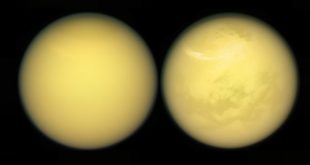
Saturn’s moon Titan is a fascinating celestial object, and not just because it orbits another planet. Titan has more than twice as much surface area as our moon and is one of two known objects with stable bodies of liquid on the surface — the other is Earth. Although, on …
Read More »World’s Oldest Flying Squirrel Fossil Discovered
An international team of paleontologists has found the world’s oldest flying squirrel fossil — an 11.63-million-year-old specimen of an extinct species called Miopetaurista neogrivensis — at the Abocador de Can Mata site in Barcelona, Catalonia, Spain. Life appearance of the fossil flying squirrel Miopetaurista neogrivensis showing the animal ready to …
Read More »Researchers Find New Way to Prevent Acute Asthmatic Symptoms
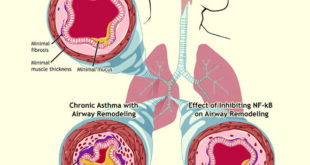
Asthma is one of the most common lung diseases, affecting 241 million people worldwide. This disease is characterized by airflow limitation caused by inflammation, excess mucous secretion, remodeling changes, such as goblet cell metaplasia and increased smooth muscle mass and acute conducting airway constriction in response to stimuli, usually allergens. …
Read More »Study: Humans Inherited Viral Defenses from Neanderthals
Neanderthal DNA introgressed in modern humans helped them adapt against RNA viruses, according to new research published in the journal Cell. Interbreeding between Neanderthals and modern humans gave us genetic tools to combat viral infections. Image credit: Claire Scully. Current thinking is that modern humans began moving out of Africa …
Read More »Extra DNA Produces Blue Eyes in Huskies
In a study examining the DNA of over 6,000 dogs, researchers at Embark Veterinary, Inc., Boston, Massachusetts, have identified that duplication of a part of canine chromosome 18 is strongly associated with blue eyes in Siberian Huskies. Blue eyes are iconic of the Siberian Husky, a breed of northern latitudes. …
Read More »Boeing May Be Funding Op-Ed Campaign Attacking SpaceX Across the Country
Companies like Boeing and SpaceX may both be working with NASA to return Americans to space in rockets and crew vessels of our own design. The companies are competitors, not partners, and they’re competing for some of the most lucrative, important contracts of the 21st century. They also aren’t friends …
Read More »Cassini Detected ‘Ring Rain’ During Plunge into Saturn
It has been more than a year since the iconic Cassini probe ended its mission by diving into the atmosphere of Saturn, the planet it studied for more than a decade. However, Cassini is the mission that just keeps on giving. Scientists are still analyzing the data collected by Cassini …
Read More »Lockheed Wants to Build a Lunar Lander for NASA’s Gateway Station
NASA representatives have spoken in the past about returning to the moon as a stepping stone to Mars, but it was always in the vaguest of terms. The agency recently formalized its plans with the aim of building an orbital moon station called The Gateway. One glaring omission from the …
Read More »
#Bizwhiznetwork.com Innovation ΛI |Technology News