The Hubble Space Telescope is creeping ever closer to 30 years old, and nothing lasts forever. Scientists are acutely aware of that today after placing the orbiting observatory into safe mode following the failure of another gyroscope. The team is currently working to bring another gyro online, but Hubble may …
Read More »Giant Ice Spikes on Europa Could Endanger Future Landers
Jupiter’s moon Europa has captured the attention of scientists with its likely subsurface ocean and cracked icy shell, but visiting the distant iceball might be even harder than we thought. A new analysis of the conditions on Europa says we could encounter pointy spears of ice on the surface up …
Read More »Oldest Known Fragment of Homer’s Odyssey Found on Clay Tablet
Archaeologists in Greece have discovered what they think is the oldest written record of Homer’s poem Odyssey. The clay tablet contains 13 verses from the Odyssey’s 14th rhapsody. Image credit: Hellenic Ministry of Culture and Sports. The clay tablet, inscribed around 200-300 CE (Roman era), was unearthed near the Temple …
Read More »Flatbread Baked 14,400 Years Ago Found in Jordan
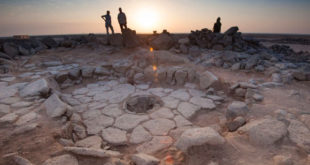
Archaeologists from the Universities of Copenhagen and Cambridge, and University College London have unearthed the charred remains of a flatbread baked by Natufian hunter-gatherers 14,400 years ago. The results, published in the Proceedings of the National Academy of Sciences, provide the earliest empirical evidence for the production of bread, and …
Read More »Archaeologists Find Pre-Clovis Projectile Points in Texas
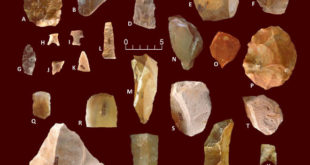
At the Gault archaeological site in central Texas, archaeologists have unearthed a projectile point technology never previously seen in North America, which they date to be 16,000-20,000 years old. The findings, published in the journal Science Advances, suggest humans occupied the North American continent prior to Clovis — considered the …
Read More »Neanderthals Could Start Fires with Mineral Pyrite and Stone Tools
New research published in the journal Scientific Reports provides clear evidence that Neanderthals made fire by striking a piece of pyrite, the yellow mineral sometimes known as fool’s gold, against flint tools called bifaces. The occasional use of stone tools as ‘strike-a-lights’ was a technocultural feature shared among Neanderthals in …
Read More »Study Claims Dingoes Reached Australia 3,500 Years Ago
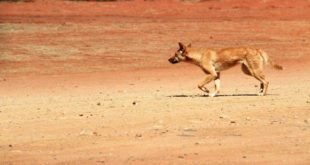
A team of scientists in Australia has uncovered new evidence that suggests dingoes (Canis familiaris dingo) arrived on the continent around 3,500 years ago, more recently than previously thought. Balme et al present the results of direct dating of dingo bones from their oldest known archaeological context, Madura Cave on …
Read More »Ancient Pottery Reveals Japanese Hunter-Gatherers’ Taste for Fish
In one of the largest studies of its kind, an international team of researchers conducted organic residue analysis of almost 800 ceramic vessels from 46 Jomon culture archaeological sites, dated to between 13,000 and 6,000 BC, in Japan to identify their contents. The results, published in the Proceedings of the …
Read More »Homo erectus Were Technologically Conservative, Used Least-Effort Strategies, Researchers Say
Archaeological excavations at the Acheulean site of Saffaqah near Dawadmi in central Saudi Arabia have found that Homo erectus, an extinct hominid species that lived between 1.9 million and 143,000 years ago, used ‘least-effort strategies’ for tool making and collecting resources. This is an artist’s reconstruction of Homo erectus. Image …
Read More »Enormous Drought Played Significant Role in Maya Civilization’s Collapse
There are multiple theories as to what caused the collapse of the Classic Maya civilization, such as invasion, war, environmental degradation, etc. In the 1990s, however, researchers were able to piece together climate records for the period of the Maya collapse, and found that it correlated with an extreme drought. …
Read More »
#Bizwhiznetwork.com Innovation ΛI |Technology News