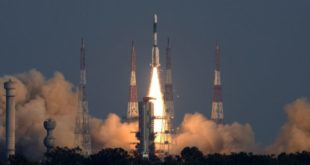
December 19th was supposed to be a banner day for the spaceflight industry. We expected as many as five launches in just one day, but things took a turn early on as the first rockets were set to take off. Of the five possible launches, only two of them headed …
Read More »NASA’s InSight Lander Places the First-Ever Seismic Sensor on Mars
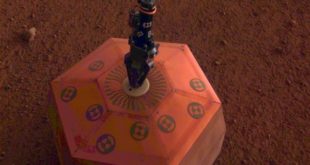
Landing InSight on the surface of Mars was an incredible feat all by itself, but the robot has just successfully completed its first major mission milestone. After carefully surveying the nearby terrain, NASA pinpointed a location to deploy the lander’s Seismic Experiment for Interior Structure (SEIS). InSight successfully placed the …
Read More »Fossil Clue Found to Ancient Clash between Shark and Pteranodon
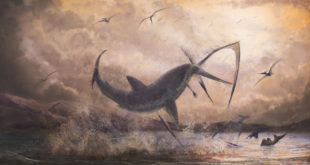
In a paper in the journal PeerJ, paleontologists report finding a shark tooth embedded in an 80-million-year-old cervical vertebra of the large flying reptile called Pteranodon. Life reconstruction of a c. 8.2 foot (2.5 m) long breaching Cretoxyrhina mantelli biting the neck of a 16.4 foot (5 m) wingspan Pteranodon …
Read More »InSight Deploys First Instrument onto Martian Surface
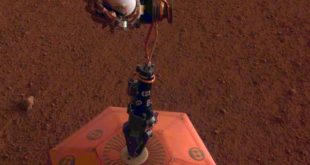
On Wednesday, December 19, 2018, NASA’s InSight lander deployed its first instrument — the Seismic Experiment for Interior Structure (SEIS) — onto the surface of Mars. NASA’s InSight lander placed its seismometer on Mars on December 19, 2018. Image credit: NASA / JPL-Caltech. “Seismometer deployment is as important as landing …
Read More »Saltriovenator zanellai: New Carnivorous Dinosaur Unveiled
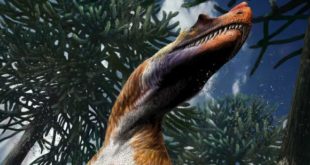
A partial skeleton of a ceratosaurian theropod dinosaur unearthed over two decades ago in Italy has been recognized as belonging to a new genus and species. Life reconstruction of Saltriovenator zanellai. Image credit: Davide Bonadonna. The newly-identified dinosaur belongs to Ceratosauria (ceratosaurs), a group of large-bodied theropod dinosaurs. Named Saltriovenator …
Read More »Primrose Genome Sequenced
A team of researchers from the University of East Anglia, Earlham Institute and the UK’s National Institute for Agricultural Botany has successfully sequenced the genome of the common primrose (Primula vulgaris), a species of flowering plant native to western and southern Europe, northwest Africa, and parts of southwest Asia. The …
Read More »Saturn’s Rings Could Be Gone in Just 100 Million Years
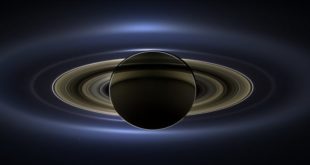
When we think about the planets, we tend to think of them as static and unchanging. While the planets unquestionably evolved into their current states, most of that evolution appears to have happened hundreds of millions to billions of years in the past. Mars has been a cold, frozen rock …
Read More »Early Cretaceous Dinosaur Footprints Discovered in Southern England
Paleontologists in southern England have uncovered a set of well-preserved footprints made by at least seven different dinosaur species about 140 million years ago (Early Cretaceous epoch). Two large iguanodontian footprints with skin and claw impressions from the Lee Ness Sandstone of the Ashdown Formation. Image credit: Neil Davies. University …
Read More »Implantable Vagus Nerve Stimulation Device Aids Weight Loss
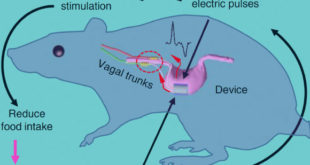
An international team of researchers led by University of Wisconsin-Madison scientists has developed an easily implantable weight-loss device. In lab experiments, the device helped rats shed 38% of their body weight. Operation principle of the vagus nerve stimulation (VNS) system schematically showing the pathway for biphasic electric signal generation and …
Read More »New Horizons Sees No Moons or Rings around Ultima Thule, Opts for Primary Flyby Path
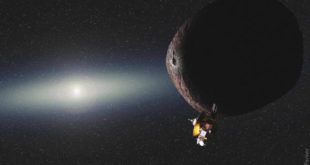
After several weeks of sensitive searches for rings, small moons and other potential hazards around 2014 MU69, a Kuiper belt object nicknamed Ultima Thule, the dozen-member New Horizons hazard watch team gave the ‘all clear’ for the spacecraft to remain on a path that takes it about 2,200 miles (3,500 …
Read More »
#Bizwhiznetwork.com Innovation ΛI |Technology News