A team of scientists at the University of Washington has genetically modified a common houseplant, the pothos ivy (Epipremnum aureum), to efficiently remove two toxins — chloroform and benzene — from the air around it. The transgenic plant expresses a protein that transforms toxins into molecules that the plant can …
Read More »Slime Mold Can Solve Exponentially Complicated Problems in Linear Time
Researchers from Lanzhou University in China have shown that the slime mold Physarum polycephalum is able to solve the Traveling Salesman Problem, a combinatorial test with exponentially increasing complexity, in linear time. Using focused light stimulus as negative feedback to maintain the criteria of the task, the authors demonstrated that …
Read More »Rosetta Detects Signs of Infant ‘Bow Shock’ at Comet 67P/Churyumov-Gerasimenko
The ‘bow shock’ is the first boundary the solar wind encounters as it approaches planets or comets. From 2014 to 2016, ESA’s Rosetta orbiter studied 67P/Churyumov-Gerasimenko and its surroundings from near and far. The spacecraft flew directly through the bow shock several times both before and after the comet reached …
Read More »Loop Quantum Gravity Theory Could Answer Fundamental Questions about Black Holes
Loop quantum gravity is a theory that uses quantum mechanics to extend gravitational physics beyond Einstein’s theory of general relativity. Previous work in loop quantum gravity analyzed the quantum nature of the Big Bang, and now two new works, published in the journal Physical Review Letters and the journal Physical …
Read More »Plant Fossil from Early Jurassic Pushes Back Origin of Flowers
An international team of paleontologists has identified and described a new genus and species of extinct flowering plant (angiosperm), based on over 200 specimens from the South Xiangshan Formation, China. Named Nanjinganthus dendrostyla, the newly-identified plant species dates back to more than 174 million years ago (Early Jurassic epoch), making …
Read More »New Horizons Team Puzzled by Lack of Light Curve from Ultima Thule
Over the past three months, NASA’s New Horizons spacecraft has been taking images to measure the brightness of its next flyby target — a Kuiper belt object nicknamed Ultima Thule (also known as 2014 MU69) — and how the brightness varies as the object rotates. Even though New Horizons team …
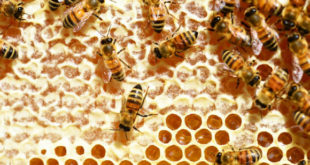
Read More »Bees Can Solve Counting Tasks with Just Four Neurons, New Study Shows
Bees can count up to four or five items, can choose the smaller or the larger number from a group and even choose ‘zero’ against other numbers when trained to choose ‘less.’ According to a new study, published in the journal iScience, bees might have achieved this not by understanding …
Read More »Mars Express Sends Back Stunning Image of Ice-Filled Korolev Crater
Scientists are still unsure if liquid water exists on Mars, but we know there’s plenty of water ice. The ice on Mars is usually diffuse and found in small pockets mixed with frozen carbon dioxide, but the Mars Express probe just beamed back images of a massive deposit of pristine …
Read More »Study: Dietary Fructose and Glucose Target Good Gut Bacteria
Dietary fructose and glucose, which are prevalent in the Western diet, silence a key protein that is necessary for gut colonization, but not for utilization of these sugars, by a beneficial bacterium called Bacteroides thetaiotaomicron, according to new research from Yale School of Medicine. Bacteroides thetaiotaomicron. Image credit: Kathryn Cross …
Read More »ESA’s Mars Express Orbiter Spots Water Ice-Filled Crater
New images from the High Resolution Stereo Camera (HRSC) on ESA’s Mars Express spacecraft show an impact crater in the northern lowlands of Mars. Known as Korolev, this 51-mile (82 km) wide crater is filled with water ice all year round. Perspective view of Korolev crater. Image credit: ESA / …
Read More »
#Bizwhiznetwork.com Innovation ΛI |Technology News