December 10, 2020
Paleontogly
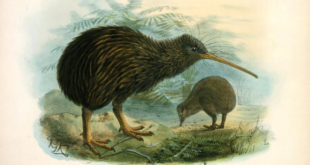
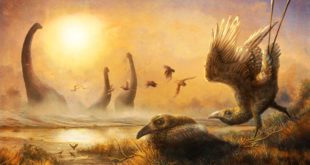
Some probe-foraging birds locate their buried prey by detecting vibrations in the substrate using a specialized tactile bill-tip organ. This remarkable ‘sixth sense’ is known as remote touch, and the associated organ is found in probe-foraging species belonging to both the palaeognathous (in kiwi) and neognathous (in ibises and shorebirds) …
Read More »
December 10, 2020
Paleontogly
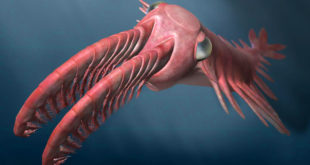
A team of paleontologists from Australia and the United Kingdom has found that ancient deep-sea creatures called radiodonts developed sophisticated eyes over 500 million years ago (Cambrian period), with some specially adapted to the dim light of deep water. An artist’s reconstruction of ‘Anomalocaris’ briggsi. Image credit: Katrina Kenny. Radiodonts …
Read More »
December 10, 2020
Paleontogly
A new genus and species of probainognathian cynodont that roamed our planet during the Triassic period has been identified from two fossilized specimens found in southern Brazil. Life reconstruction of Agudotherium gassenae. Image credit: Márcio L. Castro. The new cynodont species lived approximately 218 million years ago (Late Triassic epoch). …
Read More »
December 2, 2020
Paleontogly
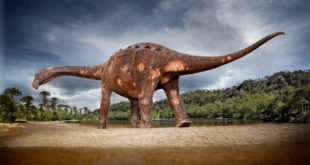
A giant sauropod dinosaur that lived 85.2 million years ago (Cretaceous period) in what is now Brazil had an aggressive case of osteomyelitis in its leg and soft-bodied parasitical microorganisms in its vascular canals. Life reconstruction of the titanosaur from the Upper Cretaceous Adamantina Formation in São Paulo backcountry, southeastern …
Read More »
December 1, 2020
Paleontogly
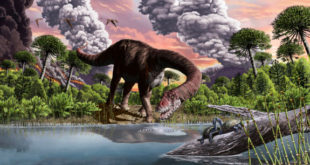
Paleontologists in Argentina have identified a new species of eusauropod (true sauropod) dinosaur that lived 179 million years ago, just after the mysterious disappearance of non-eusauropod sauropodomorphs. Life reconstruction of Bagualia alba. Image credit: Jorge González. The newly-identified dinosaur lived in what is now Patagonia, Argentina during the Early Jurassic …
Read More »
December 1, 2020
Paleontogly
Paleontologists in Madagascar have identified a new genus and species of enantiornithine bird that had a long and deep beak, a morphology that was previously unknown among Mesozoic birds. Falcatakely forsterae amidst non-avian dinosaurs and other animals from the Late Cretaceous of Madagascar. Image credit: Mark Witton. The newly-identified bird …
Read More »
November 25, 2020
Paleontogly
A new genus and species of medium-sized abelisaurid dinosaur has been unearthed in northern Patagonia, Argentina. An artist’s impression of Rajasaurus narmadensis, a cousin of the newly-discovered abelisaurid dinosaur Niebla antique. Image credit: Bogdanov / CC BY-SA 3.0. Scientifically named Niebla antique, the new dinosaur species lived approximately 69 million …
Read More »
November 23, 2020
Paleontogly
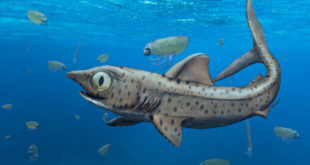
Paleontologists in Morocco have found fossil fragments from a previously undescribed genus and species of symmoriiform shark that lived during the Late Devonian epoch. Ferromirum oukherbouchi reconstructed in association with invertebrates (orthocerid cephalopods and thylacocephalans) from the Devonian of Maider region, Morocco. Image credit: Frey et al., doi: 10.1038/s42003-020-01394-2. The …
Read More »
November 21, 2020
Paleontogly
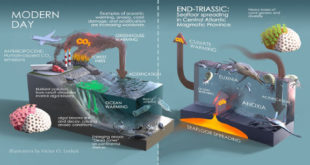
An analysis of biomarkers and their stable isotopic compositions from the Bristol Channel Basin at St. Audrie’s Bay and Lilstock, United Kingdom, has shed new light on when one of the largest mass extinction events on Earth occurred. Schematic diagram showing the factors driving global ecological change in the modern …
Read More »
November 19, 2020
Paleontogly
A new species of sandpiper has been identified from multiple Holocene fossil bones collected several decades ago on Henderson Island, an uninhabited island in the South Pacific Ocean. The extinct Kiritimati sandpiper (Prosobonia cancellata), a close cousin of the newly-discovered Henderson sandpiper (Prosobonia sauli). Illustration by George Edward Lodge, 1907. …
Read More »
 #Bizwhiznetwork.com Innovation ΛI |Technology News