January 22, 2021
Paleontogly
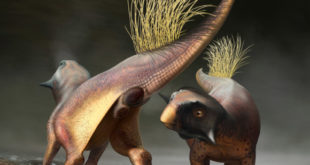
Although paleontologists know now much about dinosaurs and their appearance, they have not known anything about how their cloacal region — the all-purpose opening used for defecation, urination and breeding — appears. Paleontologists from the United Kingdom and the United States have now described the cloacal opening of Psittacosaurus, an …
Read More »
January 22, 2021
Paleontogly
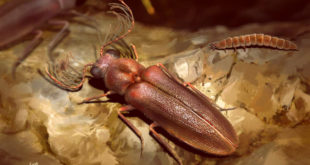
Found in a piece of mid-Cretaceous amber from northern Myanmar, the wonderfully-preserved male of Cretophengodes azari has a light organ on the abdomen which presumably served a defensive function. An artistic reconstruction of Cretophengodes azari; the larviform female in the background is reconstructed based on extant Phengodidae and Rhagophthalmidae beetles. …
Read More »
January 22, 2021
Paleontogly
A new genus and species of caimanine alligatorid being named Chinatichampsus wilsonorum has been discovered by a team of paleontologists from Virginia Tech, the University of Texas at Austin, and the University of Iowa. Holotype of Chinatichampsus wilsonorum: (A) cranium in dorsal view; (B) interpretive line drawing; gray areas indicate …
Read More »
January 22, 2021
Paleontogly
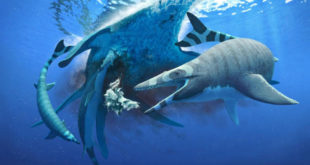
A bizarre new genus and species of mosasaur with teeth unlike those of any known reptile has been identified from fossils found in Morocco. Life reconstruction of Xenodens calminechari. Image credit: Andrey Atuchin. The mosasaurs were a group of lizards that became highly specialized for marine life in the mid-Cretaceous …
Read More »
January 22, 2021
Paleontogly
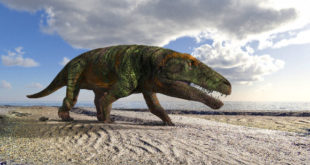
Paleontologists in Italy have discovered an assemblage of fossil footprints left by an Early Triassic archosauriform. Life appearance of the non-archosaurian archosauriform, the most suitable producer of Isochirotherium gardettensis. Image credit: Fabio Manucci. The archosauriform footprints were spotted at a paleontological site on the Gardetta Plateau in the Western Alps, …
Read More »
January 16, 2021
Paleontogly
An international team of paleontologists from Austria and Switzerland has uncovered an exceptionally well-preserved skeleton of Asteracanthus ornatissimus, a species of hybodontiform shark that lived about 150 million years ago (Jurassic period), in the famous limestones of Solnhofen in Germany. Tentative life reconstruction of the hybodontiform shark Asteracanthus ornatissimus. Image …
Read More »
January 14, 2021
Paleontogly
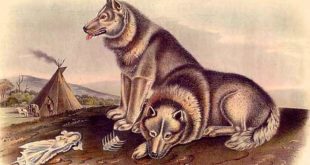
New research led by the University of Helsinki suggests that dog domestication needs to be understood in terms of competition over resources in the particularly severe environment that prevailed in northern Eurasia during the latter part of the Last Ice Age (29,000 to 14,000 years ago). Humans feeding leftover lean …
Read More »
January 14, 2021
Paleontogly
A new species of small vulture that lived during the Quaternary period in the Greater Antilles has been identified from fossils found in western Cuba. Hypothetical reconstruction of the Emslie’s vulture (Cathartes emsliei). Image credit: William Suárez. “Two species of New World vultures (family Cathartidae) form part of the modern …
Read More »
January 14, 2021
Paleontogly
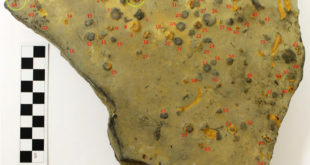
Paleontologists have described the first three-dimensional preservation of soft tissue in Namacalathus hermanastes, a skeletal metazoan (multicellular animal) that lived some 547 million years ago (Ediacaran period) in what is now Namibia, and established a strong evolutionary link between Ediacaran and early Cambrian metazoans. Namacalathus (individuals numbered). Centimeter scale. Image …
Read More »
January 11, 2021
Paleontogly
Paleontologists from the Royal Ontario Museum and the University of Toronto have found and examined the fossilized remains of two subadult and one adult saber-toothed tigers (Smilodon fatalis) — likely a mother and two adolescents — in the Pleistocene coastal deposits in Ecuador. Their results show that saber-toothed tigers had …
Read More »
 #Bizwhiznetwork.com Innovation ΛI |Technology News