October 21, 2020
Paleontogly
A new genus and species of mammaliaform that lived during the Triassic period has been identified from a partial jaw with teeth found on the eastern coast of Greenland. It represents the earliest known example of a dentary bone with double molariform roots and a crown with two rows of …
Read More »
October 17, 2020
Paleontogly
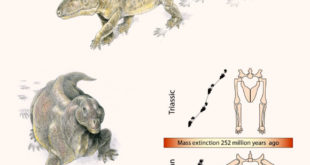
The ancestors of both mammals and birds became warm-blooded at the same time, some 250 million years ago, in the time of the end-Permian mass extinction, according to new research from the University of Bristol. Posture shift at the end of the Permian period, 252 million years ago. Before the …
Read More »
October 10, 2020
Paleontogly
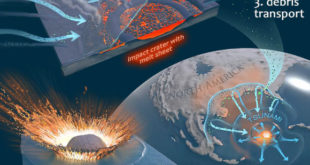
A team of researchers from the US, the UK and Australia has analyzed burn markers from the boundary of the impact site of the Chicxulub crater in the Yucatán Peninsula in the southern Gulf of Mexico and the surrounding ocean to determine what caused the impact winter, a prolonged period …
Read More »
October 10, 2020
Paleontogly
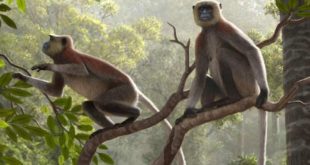
Paleontologists have found the remains of Mesopithecus pentelicus — an extinct species of Old World monkey that lived in Europe and Asia between 7 and 5 million years ago — in the Shuitangba lignite mine in northeastern Yunnan Province, China. The discovery indicates that this monkey species existed in Asia …
Read More »
October 9, 2020
Paleontogly
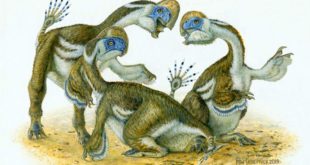
Paleontologists in Mongolia have found the fossilized skeletal remains from a new genus and species of two-fingered oviraptorosaur that walked the Earth during the Cretaceous period. Three individuals of Oksoko avarsan. Image credit: Michael W. Skrepnick. The newly-discovered dinosaur lived approximately 68 million years ago (Maastrichtian stage of the Late …
Read More »
October 6, 2020
Paleontogly
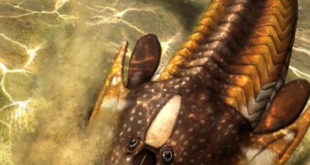
Osteostraci, the jawless sister group to all jawed vertebrates, had adaptations for passive control of water flow around the body, according to new research led by the University of Bristol. Life restoration of Cephalaspis, a typical osteostracan, swimming over the substrate. Image credit: Hugo Salais, Metazoa Studio. Osteostraci (osteostracans) is …
Read More »
October 6, 2020
Paleontogly
A new genus and species of sebecosuchian crocodyliform that roamed Earth during the Cretaceous period has been identified from a partial skeleton found in a titanosaur nesting area in Catalonia, Spain. Life restoration of Ogresuchus furatus. Image credit: Aina and Agnès Amblás / Institut Català de Paleontologia Miquel Crusafont. Named …
Read More »
September 30, 2020
Paleontogly
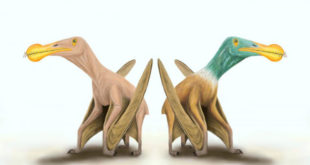
Dr. David Unwin from the University of Leicester and University of Portsmouth’s Professor Dave Martill believe Mesozoic flying reptiles called pterosaurs had a relatively smooth skin without any covering. An artist’s impression of a bald pterosaur and a feathered pterosaur. Image credit: Megan Jacobs, University of Portsmouth. Pterosaurs were Earth’s …
Read More »
September 28, 2020
Paleontogly
Paleontologists in Tasmania have unearthed the fossilized remains of a previously unknown species of the trilobite genus Gravicalymene and named it after Thomas Stewart Baker, the fourth actor to play the title character in the television series ‘Doctor Who.’ Gravicalymene bakeri. Scale bar – 1 cm. Image credit: Smith Ebach. …
Read More »
September 21, 2020
Paleontogly
A new genus and species of an early ornithopod dinosaur has been identified from two nearly complete skeletons found in China’s Liaoning Province. Changmiania liaoningensis, an anterior part of the holotype in caudolateral view; red arrow indicates the emplacement of the gastrolith clusters. Image credit: Yang et al, doi: 10.7717/peerj.9832. …
Read More »
 #Bizwhiznetwork.com Innovation ΛI |Technology News