December 28, 2020
Paleontogly
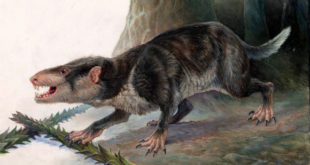
An early mammal called Priacodon fruitaensis was well adapted for powerful and precise biting, and had a varied faunivorous diet that likely included insects and small vertebrates, according to a University of Bonn-led study. Life restoration of the carnivorous mammal Gobiconodon, a distant relative of Priacodon fruitaensis. Image credit: Pavel …
Read More »
December 26, 2020
Paleontogly
A team of paleontologists from Oregon State University and the Agricultural Research Service of the U.S. Department of Agriculture has found a new genus and species of fossil angiosperm in the mid-Cretaceous amber deposits of Myanmar. Valviloculus pleristaminis, flower in lateral view. Image credit: Poinar, Jr. et al., doi: 10.17348/jbrit.v14.i2.1014. …
Read More »
December 23, 2020
Paleontogly
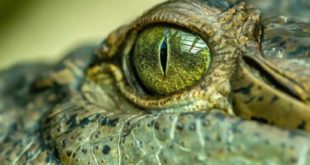
A new genus and species of prehistoric crocodile, Paludirex vincenti, has been identified from fossils unearthed in Queensland, Australia. Paludirex vincenti belongs to Mekosuchinae, an extinct subfamily of crocodylids from Australia and the South Pacific. Image credit: University of Queensland. Paludirex vincenti roamed Earth during the Pliocene epoch, between 5 …
Read More »
December 23, 2020
Paleontogly
An ancient wolf pup, named Zhùr (means ‘wolf’ in the Hän language of the local Tr’ondëk Hwëch’in people), lived approximately 57,000 years ago and died in her den during a collapse of the sediments; during her short life, she ate aquatic resources, and is related to ancient Beringian and Siberian …
Read More »
December 20, 2020
Paleontogly
A new genus and species of medium-sized python that lived during the early-middle Eocene period has been identified from several nearly complete skeletons and partial skulls found in Germany. Messelopython freyi. Image credit: Senckenberg Research Institute. The newly-identified python species lived in what is now Germany, approximately 47.6 million years …
Read More »
December 17, 2020
Paleontogly
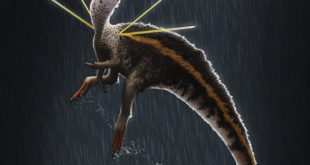
A maned theropod dinosaur with elaborate filamentous structures has been identified by a research team led by University of Portsmouth paleontologists. Life restoration of Ubirajara jubatus. Image credit: Bob Nicholls, paleocreations.com. The newly-discovered dinosaur species lived about 110 million years ago (Aptian stage of the Cretaceous period) in what is …
Read More »
December 17, 2020
Paleontogly
A team of paleontologists from the University of Bristol and the Oxford University Museum of Natural History has digitally reconstructed the brain of Thecodontosaurus antiquus, a species of small sauropodomorph dinosaur that lived some 205 million years ago (Late Triassic epoch), and found that this dinosaur may have eaten meat, …
Read More »
December 15, 2020
Paleontogly
Pterosaurs were highly successful reptiles that lived between 210 and 65 million years ago. They were the first vertebrates to evolve powered flight, but their origin has remained an unresolved enigma in paleontology since the 19th century. With the help of pterosaur skulls and skeletons that were unearthed in North …
Read More »
December 15, 2020
Paleontogly
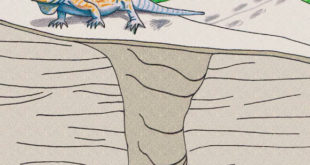
A trace fossil preserved in the Grotto Beach Formation on San Salvador Island, the Bahamas, is the first known fossil example of an iguana nesting burrow. Illustration shows a cross section of the prehistoric iguana burrow, and how the surrounding landscape may have looked during the Late Pleistocene epoch. Image …
Read More »
December 14, 2020
Paleontogly
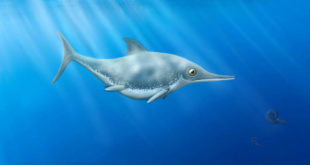
A new genus and species of ophthalmosaurid ichthyosaur that swam in the Late Jurassic seas has been identified from an exceptionally well-preserved specimen found in Dorset, England. An artist’s impression of Thalassodraco etchesi. Image credit: Megan Jacobs. Ichthyosaurs were a successful group of large marine reptiles for most of the …
Read More »
 #Bizwhiznetwork.com Innovation ΛI |Technology News