Science

Fireflies under Threat of Extinction because of Habitat Loss, Pesticides, Artificial Light, Report Says

An international team of entomologists has conducted a survey of experts from diverse geographic regions to identify the most prominent perceived threats to firefly population and species persistence. Habitat loss, light pollution, and pesticide use were regarded as the most serious threats, although rankings differed substantially across regions. A female …

Read More »

Researchers Find New Way to Analyze Chemistry of Lunar Soil

An international team of planetary scientists and geochemists from the United States and Switzerland has demonstrated that a technique called atom probe tomography can be successfully used to characterize the composition and texture of single grains of lunar dust at near-atomic resolution. A tiny grain of lunar soil brought back by …

Read More »

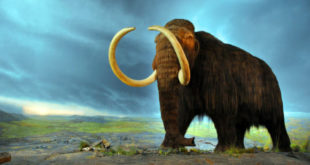
Scientists ‘Resurrect’ Mutated Genes of Wrangel Island Mammoths

Woolly mammoths (Mammuthus primigenius) were among the most abundant cold adapted species during the Pleistocene. Their once large populations went extinct in two waves, an end-Pleistocene extinction of continental populations followed by the mid-Holocene extinction of relict populations on St. Paul Island, a small island in the middle of the …

Read More »

Jurassic Fossil Shows Pterosaurs Preyed on Soft-Bodied Cephalopods

Paleontologists in Germany have found the 150-million-year-old fossilized remains of the extremely rare squid Plesioteuthis subovata preserved with a tooth of a pterosaur species called Rhamphorhynchus muensteri. Reconstruction of the hunting behavior of Rhamphorhynchus muensteri, flying close to the water surface to grab soft-bodied cephalopods such as Plesioteuthis subovata that …

Read More »

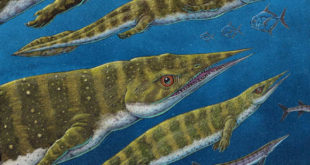
Paleontologists Identify New Species of Thalattosaur

A new species of marine reptile from the Triassic period has been identified from fossils found in southeastern Alaska, the United States. An artist’s depiction of Gunakadeit joseeae. Image credit: Ray Troll. Thalattosaurs (meaning ‘ocean lizards’) were among several reptile lineages that adapted to marine life in the Mesozoic era. …

Read More »

Physicists Discover New Quasiparticle

Named π-ton (pi-ton), the newly-discovered quasiparticle consists of two electrons and two holes. Two electrons and two holes, created by light quanta, held together by a chessboard-like background. Image credit: TU Wien Quasiparticle is a disturbance in a medium that behaves as a particle and that may conveniently be regarded …

Read More »
Bizwhiznetwork Consultation