Science

Newly-Discovered Microbe Turns Oil into Methane
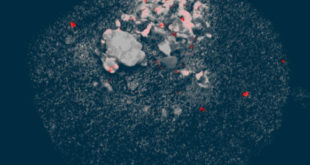
Methanoliparia, a species of archaea from deep-sea oil seeps of the Gulf of Mexico, splits long-chain hydrocarbons into methane and carbon dioxide, according to a new paper published in the journal mBio. Methanoliparia is an important methanogenic alkane degrader in subsurface environments, producing methane by alkane disproportionation as a single …

Read More »

8,000-Year-Old Wooden Platform Found Off Isle of Wight

Underwater archaeologists working off the coast of the Isle of Wight have discovered an 8,000-year-old structure next to what is believed to be the world’s oldest known boat building site. Historian Dan Snow inspecting the 8,000-year-old wooden platform off the coast of the Isle of Wight, UK. Image credit: Maritime …

Read More »

NASA Moves Forward With Europa Clipper Mission

  NASA is moving ahead with one of its most ambitious upcoming missions. The Europa Clipper has cleared a major bureaucratic hurdle, allowing the agency to begin final design and construction of the spacecraft that will explore the icy moon of Jupiter. The mission will begin to take shape over …

Read More »

Methane not released by wind on Mars, experts find

Credit: CC0 Public Domain Wind erosion has been ruled out as the primary cause of methane gas release on Mars, Newcastle University academics have shown.   Methane can be produced over time through both geological and biological routes and since its first detection in the Martian atmosphere in 2003, there …

Read More »

New Species of Medicinal Leech Discovered

An international team of biologists has discovered and described a new species of medicinal leech living in the freshwater wetlands of the eastern United States. It is the first description of a North American medicinal leech since 1975. Macrobdella mimicus. Image credit: Ian Cook. Leeches are parasitic worms, many of …

Read More »

Archaeologists Unearth 45,000-Year-Old Stone Tools in Mongolia

A collection of stone artifacts unearthed at the archaeological site of Tolbor-16 in the northern Khangai Mountains of Mongolia indicate that anatomically modern Homo sapiens traveled across the Eurasian steppe 45,000 years ago, about 10,000 years earlier than previously thought. The Tolbor-16 site (arrow) in the western flank of the …

Read More »

Long-Duration Spaceflight Alters Brain Connectivity: Study

An international team of scientists has found alterations of task-based functional brain connectivity in a group of astronauts after a long-duration spaceflight. The findings appear in the journal Frontiers in Physiology. JAXA astronaut Aki Hoshide, ISS Expedition 32 flight engineer, taking a space selfie during extravehicular activity on September 5, …

Read More »
Bizwhiznetwork Consultation