Science

Physicists Detect Four New Gravitational Waves

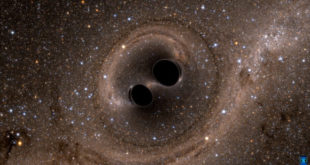
The twin LIGO (Laser Interferometer Gravitational-Wave Observatory) detectors, located in Livingston, Louisiana, and Hanford, Washington, and the Virgo detector located near Pisa, Italy, have detected four new gravitational waves — ripples in the fabric of spacetime. The collision of two black holes is seen in this still from a computer …

Read More »

NASA’s OSIRIS-REx Spacecraft Arrives at Asteroid Bennu

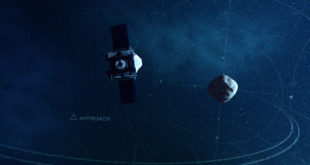
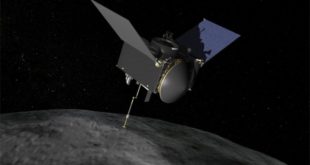
After traveling through space for more than two years and 1.2 billion miles (2 billion km), NASA’s OSIRIS-REx (Origins, Spectral Interpretation, Resource Identification, Security-Regolith Explorer) spacecraft arrived at its destination — asteroid Bennu (formerly 1999 RQ36) — on December 3, 2018. NASA’s OSIRIS-REx spacecraft is on a mission to explore …

Read More »

NASA’s OSIRIS-REx Probe Reaches Asteroid Bennu

After two years in space, NASA’s OSIRIS-REx probe has reached its destination: the asteroid Bennu. The rendezvous is already a significant achievement, but the mission is far from over. Eventually, OSIRIS-REx will graze the surface of Bennu to pick up a tiny bit of material to send back to Earth. …

Read More »

Physicists Measure Mass Numbers of Nihonium and Moscovium

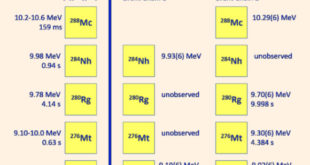
Physicists using the FIONA (For the Identification Of Nuclide A) device at the Department of Energy’s Lawrence Berkeley National Laboratory’s 88-inch Cyclotron have performed the first direct measurements of the mass numbers for the nuclei of nihonium (Nh, element 113) and moscovium (Mc, element 115). Left: average of known decay …

Read More »

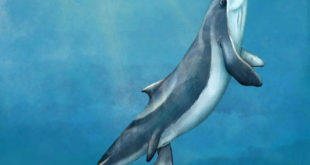
Oligocene-Epoch Whale Had Neither Teeth Nor Hair-Like Baleen

A team of U.S. paleontologists has described a remarkable new species of whale that lived about 33 million years ago (Oligocene epoch). The researchers found that this toothless whale, named Maiabalaena nesbittae, had no baleen, showing a surprising intermediary step between the baleen whales that live today and their toothed …

Read More »
Bizwhiznetwork Consultation