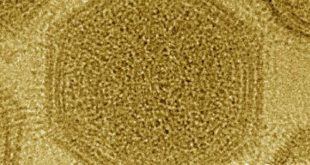
A team of researchers has isolated a new giant virus from hot spring water in Japan. Named medusavirus, the virus infects a species of amoeba called Acanthamoeba castellanii and can turn its host into a stone-like cyst. Cryo-EM image of a DNA-filled medusavirus particle viewed from a 3-fold axis; spike, …
Read More »LIGO and Virgo Observatories Detect Two New Gravitational Waves
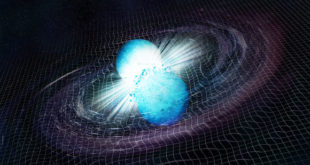
On April 25 and 26, 2019, NSF’s Laser Interferometer Gravitational-Wave Observatory (LIGO) and the European-based Virgo detector registered two new gravitational waves, the ripples in space-time predicted by Albert Einstein. The first was from a neutron star crashing into another neutron star 500 million light-years away, and the second was …
Read More »Wolves are More Prosocial than Dogs, New Study Finds
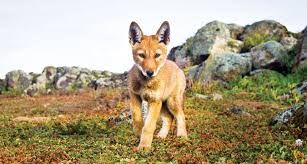
In touchscreen experiments that allowed animals to provide food to others, wolves (Canis lupus) acted more prosocially toward their pack members than did pack dogs (Canis lupus familiaris). While wolves rely heavily on cooperation, dogs do so substantially less thus leading to the prediction that wolves are more prosocial than …
Read More »Paper Wasps are Capable of Logical Thinking, Suggests New Study
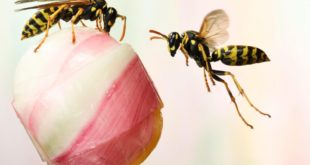
A team of researchers from the University of Michigan has found evidence of transitive inference — a form of logical reasoning that involves using known relationships to infer unknown relationships (if A is greater than B, and B is greater than C, then A is greater than C) — in …
Read More »Biologists Find Arsenic-Breathing Microbes in Oxygen-Poor Regions of Pacific Ocean
A team of marine biologists from the University of Washington has found communities of arsenic-breathing microbes in the oxygen-deficient zones of the Pacific Ocean. The findings suggest microbial arsenic metabolism may be underestimated in the modern ocean and was likely a significant contributor to biogeochemical cycles in the ancient anoxic …
Read More »Tiny Jurassic Dinosaur Had Membranous Wings
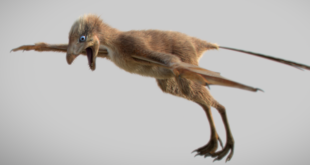
A previously unknown species of bird-like dinosaur with pterosaur-like wings has been discovered by a team of paleontologists working with the Institute of Vertebrate Paleontology and Paleoanthropology and Center for Excellence in Life and Paleoenvironment at Chinese Academy of Science. The discovery, reported in the May 9 issue of the …
Read More »The Universe’s First Supernovae May Have Been Powerful, Asymmetric Jets
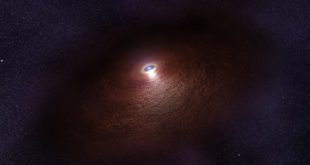
When it comes to the history of the universe, figuring out how we got what we currently exist in based on our understanding of what the earliest conditions were is something of a fun scientific puzzle, if the phrase “fun scientific puzzle” translates to “a major field of study …
Read More »Astronomers Assemble the Most Detailed Picture of the Universe Ever
“Space is big. Really big. You just won’t believe how vastly, hugely, mind-bogglingly big it is. I mean, you may think it’s a long way down the road to the chemist, but that’s just peanuts to space.” — Douglas Adams, The Hitchhiker’s Guide to the Galaxy Hubble astronomers have …
Read More »Alzheimer’s Amyloid-Beta and Tau Proteins Act as Prions, New Research Finds
Prions are misfolded versions of a protein that can spread like an infection by forcing normal copies of that protein into the same self-propagating, misfolded shape. According to new research led by the University of California, San Francisco (UCSF), Alzheimer’s disease is a double-prion disorder in which amyloid beta and …
Read More »Songbirds Have Unusual Chromosome in Germ Cells: Study
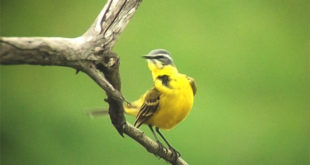
An international team of researchers has discovered that all songbirds have an additional chromosome in their germ cells — the ‘germline restricted chromosome’ (GRC). The western yellow wagtail (Motacilla flava), a small passerine bird in the family Motacillidae. Image credit: Sci-News.com. Somatic (normal) cells have two copies of each chromosome. …
Read More »
#Bizwhiznetwork.com Innovation ΛI |Technology News