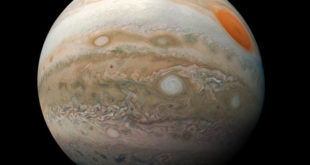
Planetary researchers from NASA’s Juno mission made the first detection beyond Earth of an internal magnetic field that changes over time — a phenomenon called secular variation. They also determined Jupiter’s secular variation is most likely driven by its atmospheric (or zonal) winds. This image of Jupiter was taken on February …
Read More »Ragweed Compounds May Help Fight Alzheimer’s Disease
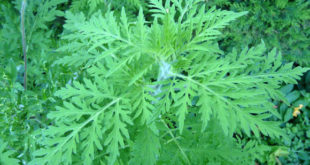
A team of scientists in Korea has identified ragweed compounds that could help neurons survive in the presence of Alzheimer’s disease peptides. The common ragweed (Ambrosia artemisiifolia). Image credit: Pere Igor / CC BY-SA 3.0. Alzheimer’s disease is a neurodegenerative disorder that features declines of judgment, cognition, memory, and behavior. …
Read More »Study: Bonobo Mothers Play Strong Role in Helping Adult Sons Find Mate
In many group-living mammals, mothers may increase the reproductive success of their adult daughters. However, whether such maternal effects exist for adult sons is largely unknown. A new study, published in the journal Current Biology, shows that adult bonobo males have higher paternity success when their mother is living in …
Read More »Scientists Create Model of Ring Around Dwarf Planet Haumea
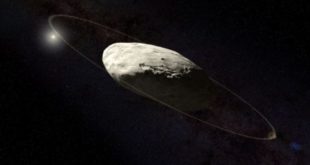
The dwarf planet Haumea orbits the sun in the deep, dark reaches of the outer solar system. Astronomers spotted this object in 2004, and it helped usher in the formal definition a “dwarf planet,” resulting in the demotion of Pluto. The longer astronomers observe Haumea, the more interesting it …
Read More »Scientists Have Spotted One of the Rarest Objects in the Universe
When astronomers peer up at the heavens, they aren’t just looking for objects we already know to exist. They also hunt for evidence of physical phenomena we think should exist but haven’t found yet. When you add up the various factors in play — the vastness of space, the …
Read More »Scientists Might Have an Explanation for Pluto’s Subsurface Ocean
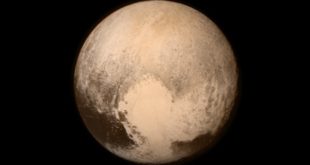
We had no idea what Pluto looked like until 2015 when the New Horizons spacecraft completed its flyby. It’s safe at this point to say that the former planet is a much more complex object than anyone dared expect. It has clouds, fields of nitrogen ice, and (surprisingly) a …
Read More »Study Sheds New Light on Origin of Libyan Desert Glass
Libyan desert glass is a natural glass found in western Egypt that formed 29 million years ago, however its origin is disputed: the two main formation hypotheses include melting by meteorite impact or melting by a large atmospheric airburst. A new study by a duo of researchers from Australia and …
Read More »Ultima Thule: Surprises in Science Results from New Horizons Mission
After flying past the dwarf planet Pluto in 2015, NASA’s New Horizons spacecraft shifted course to Ultima Thule (also known as 2014 MU69), a much smaller body about 22 miles (36 km) in length. Ultima Thule is part of the Kuiper Belt, a torus-shaped ensemble of objects in the outer …
Read More »Coffee Suppresses Gut Microbiome, Improves Ability of Intestine to Contract: Study
New experiments, performed in vitro on bacterial cultures and in vivo in rats, show that coffee — regardless of caffeine content — inhibits gut microbiota and stimulates intestinal smooth muscle contractility. Hegde et al, feeding rats coffee and also mixing it with gut bacteria in Petri dishes, found that coffee …
Read More »Archaeologists Find High-Quality Jadeite Tool at Ancient Maya Salt-Working Site in Belize
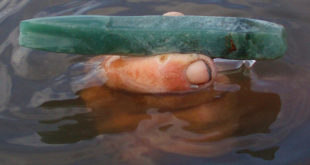
A team of archaeologists has found a jadeite gouge with a rosewood handle at Ek Way Nal, a Classic Maya salt-working site in Belize. The jadeite gouge after discovery. Image credit: Heather McKillop. Jadeite is a hard rock that varies from translucent to opaque. During the Classic Period of 300-900 …
Read More »
#Bizwhiznetwork.com Innovation ΛI |Technology News