NASA’s InSight lander doesn’t get as much attention as the Curiosity rover, but it has been on Mars and making history for almost a year. It’s sent back weather reports from the red planet, recorded the ghostly sounds of the Martian wind, and deployed the first-ever seismometer on another …
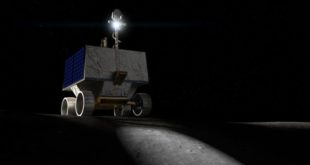
Read More »NASA Plans VIPER Lunar Mission to Map Moon’s Water Reserves
We’ve known about the likely presence of ice reserves on the Moon for decades, but we haven’t actually sent a dedicated ground-based probe to check our nearest neighbor. Instead, the presence of water ice in shadowed craters at the Moon’s south pole has been intuited from various space-based measurements …
Read More »Researchers Generate Gene Sequences for 1,124 Plant Species, Illuminate One Billion Years of Evolution
As part of the One Thousand Plant Transcriptomes (1KP) Initiative, an international consortium of scientists has sequenced transcriptomes — the set of genes that is actively expressed — of 1,124 plant species to shine a light on one-billion-year history of green plants. Diversity within the family Viridiplantae: (a-e) green algae …
Read More »Neutron Star Collision May Explain Origin of Heavy Elements
In 2017, scientists around the world were excited by the news that the Laser Interferometer Gravitational-Wave Observatory (LIGO) project had detected gravitational waves from the collision of two neutron stars. This discovery confirmed a pivotal prediction of general relativity, and eventually earned multiple Nobel Prizes. A new study now …
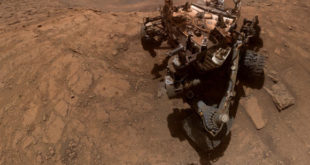
Read More »Curiosity Rover Snaps New Selfie on Mars
NASA’s Mars rover Curiosity snapped a view of itself and its surroundings on October 11, 2019 (the 2,553rd Martian day, or Sol, of its mission). The selfie (high-resolution version) is composed of 57 individual images taken by the rover’s Mars Hand Lens Imager (MAHLI), a camera on the end of …
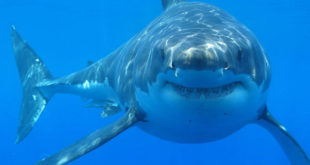
Read More »White Sharks Choose Who They Hang With, New Study Reveals
White sharks (Carcharodon carcharias) are top marine predators that are typically solitary but can also form seasonal aggregations around seal colonies to feed. Using a combination of photo-identification and network analysis, a team of researchers investigated the co-occurrence patterns of the marine predators. The study showed, for the first time, …
Read More »Astronomers Find Massive Dust-Cloaked Galaxy From the Early Universe
One of the major unanswered questions in astronomy is how our modern system of galaxies evolved into its present-day configuration in the first place. Now, researchers have found evidence of a massive galaxy that formed when the universe was far younger than it today, with a very different configuration …
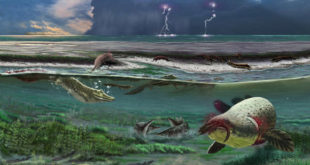
Read More »Devonian Tetrapod Had Crocodile-Like Lifestyle
Paleontologists have discovered the fossils of a new type of early tetrapod (four-limbed vertebrate) in the Komi Republic. Dubbed Parmastega aelidae, the ancient creature lived about 372 million years ago (Devonian period) and was an aquatic, surface-cruising animal. An artist’s reconstruction of the Devonian-period Sosnogorsk lagoon just before a storm. Image …
Read More »Physicists Propose New Method to Detect Traversable Wormholes
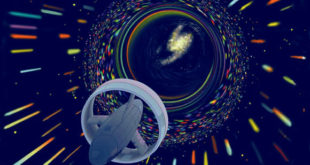
In a new paper published this month in the journal Physical Review D, a duo of theoretical physicists from Case Western Reserve University, the University at Buffalo College of Arts and Sciences and Yangzhou University described a technique for detecting traversable wormholes — theoretical portals through space-time that could create …
Read More »Study: Asteroid Impact, Not Volcanism, was Key in Driving End-Cretaceous Mass Extinction
The end-Cretaceous mass extinction 66 million years ago eradicated roughly 75% of the animal and plant species on Earth, including whole groups like non-avian dinosaurs and ammonites. Debate lingers over what caused this extinction event, with intense volcanic activity in India’s Deccan Traps and the asteroid strike off Mexico’s Yucatan …
Read More »
#Bizwhiznetwork.com Innovation ΛI |Technology News