Paleontogly

Jurassic Dinosaur Footprints Found on Scotland’s Isle of Skye

An international team of paleontologists from the University of Edinburgh, Staffin Museum and Chinese Academy of Sciences has discovered a new dinosaur tracksite at Rubha nam Brathairean (Brothers’ Point) on the Isle of Skye, Scotland. Photograph and line drawing of a sauropod footprint, one of the most striking at Brothers’ …

Read More »

Eocene Monitor Lizard Had Four Eyes: Study

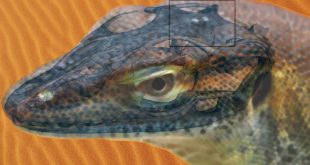
According to a new study, Saniwa ensidens — an extinct monitor lizard that lived in what is now Wyoming 51-49 million years ago (Eocene epoch) — had four eyes, a first among known jawed vertebrates. The third and fourth eyes refer to pineal and parapineal organs, eye-like photosensory structures on …

Read More »

Paleontologists Discover New Reptile from Triassic Period

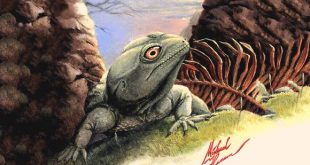
A team of paleontologists from Yale University, Smithsonian Institution and Johns Hopkins University has discovered a new species of reptile that lived 200 million years ago during the Triassic period, in what is now Connecticut in the United States. An artist’s rendering of Colobops noviportensis. Image credit: Michael Hanson. Dubbed …

Read More »

Archaeopteryx Was Active Flyer, Paleontologists Say

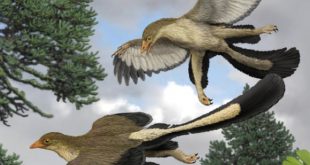
Archaeopteryx is an iconic fossil species with feathered wings from the Late Jurassic of Germany. The question of whether this dino-bird was an elaborately feathered ground dweller, a glider, or an active flyer has fascinated paleontologists for many years. European Synchrotron Radiation Facility researcher Dennis Voeten and colleagues have now …

Read More »

Paleontologists Find ‘Bubbles of Oxygen’ in 1.6-Billion-Year-Old Stromatolites

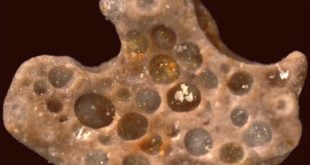
An international research team led by Swedish Museum of Natural History scientists has found that stromatolites (solid, laminar structures of biological origin) from the 1.6-billion-year-old Chitrakoot Formation in India contain abundant fossilized oxygen bubbles. Fossilized bubbles and cyanobacterial fabric from 1.6 billion-year-old phosphatized microbial mats of the Chitrakoot Formation in …

Read More »

Early Cretaceous Bird Fossil Sheds New Light on Avian Evolution

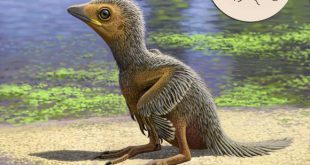
The tiny fossil of a juvenile enantiornithe bird from the Early Cretaceous La Huérguina Formation of Spain is helping paleontologists understand how early birds came into the world in the age of dinosaurs. Artist impression of a juvenile enantiornithe bird. Image credit: Raúl Martín. The 127-million-year-old fossil is a chick …

Read More »
Bizwhiznetwork Consultation