Paleontogly

Cambrian Period Worm Had Hair-Sized Bristles on Its Head and Body

A new species of bristle worm that lived about 508 million years ago (Cambrian period) has been identified from fossils found in Marble Canyon and Burgess Shale sites, both in British Columbia, Canada. Kootenayscolex barbarensis. Image credit: Danielle Dufault / Royal Ontario Museum. Dubbed Kootenayscolex barbarensis, the ancient worm was …

Read More »

Paleontologists Propose New Theory on Horse Evolution

Researchers have long wondered how horses evolved from a five-toed ancestor to the single-toed animal we know today. While it is largely believed that they simply evolved with fewer digits, Professor Nikos Solounias from the New York Institute of Technology College of Osteopathic Medicine pose a new theory that suggests …

Read More »

Caihong juji: Jurassic Bird-Like Dinosaur Had Iridescent Feathers

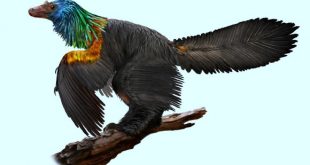
A newly discovered species of bird-like dinosaur, Caihong juji, had a beautiful iridescent coloration, according to a study published in the journal Nature Communications. Caihong juji lived in China about 161 million years ago and may have used its impressive feathers to attract mates. Image credit: Velizar Simeonovski, Field Museum. …

Read More »

New Dinosaur Species Discovered in Australia

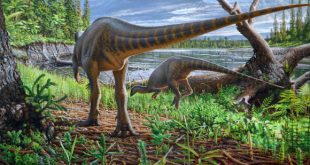
A new species of turkey-sized herbivorous dinosaur being named Diluvicursor pickeringi has been unearthed in southeastern Australia. Artist’s impression of two Diluvicursor pickeringi foraging on the bank of a high-energy river within the Australian-Antarctic rift valley. Image credit: Peter Trusler. Diluvicursor pickeringi (means Pickering’s flood-running dinosaur) lived approximately 113 million …

Read More »

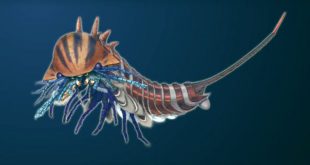
Cambrian Sea Predator Had ‘Jackknife’ Head

Habelia optata, a close relative of the ancestor of modern-day spiders, scorpions and horseshoe crabs, evolved an extremely complex head to hunt and eat shelly animals, according to new research from the University of Toronto, Canada. Artistic reconstruction of Habelia optata. This creature and its relatives were active predators of …

Read More »

Study: Simple Life Forms are Common throughout Universe

A detailed analysis of 3.465-billion-year-old microbial microfossils provides evidence to support an increasingly widespread understanding that life in the Universe is common. 3.465-billion-year-old fossil microbes indicate that life in the Universe is common. Image credit: Reimund Bertrams. Professor J. William Schopf from the University of California, Los Angeles, and his …

Read More »

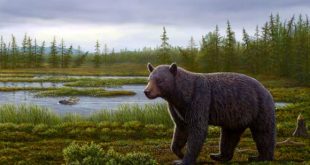
Protarctos abstrusus: Ancient Primitive Bear Had a Sweet Tooth

An international team of paleontologists has found the remains of an unusual prehistoric bear that lived 3.5 million years ago (Pliocene epoch) in Canada’s High Arctic. Reconstruction of Protarctos abstrusus in the Beaver Pond site area during the late summer. An extinct beaver, Dipoides, is shown carrying a tree branch …

Read More »

First Triassic Horseshoe Crab Fossil Found in North America

A mostly complete and moderately well-preserved fossilized specimen is thought to represent the first Triassic horseshoe crab found in North America, according to a study published in the December 2017 issue of the journal Neues Jahrbuch für Geologie und Paläontologie by paleontologist Dr. Allan Lerner from the New Mexico Museum …

Read More »
Bizwhiznetwork Consultation