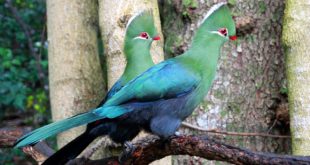
New research reveals that a well-preserved 52-million-year-old bird fossil specimen from the early Eocene of Wyoming, the United States, is from a previously unknown relative of turacos, a group of birds that is presently endemic to sub-Saharan Africa. Modern turacos, like these Knysna turacos (Tauraco corythaix), are tree-dwelling and live …
Read More »Early Devonian Fish Had Platypus-Like Snout
Brindabellaspis stensioi, a remarkable placoderm fish that swam about 400 million years ago (Early Devonian period), had a long snout, reminiscent of a platypus bill, according to new research published in the journal Royal Society Open Science. Life reconstruction of Brindabellaspis stensioi. Image credit: Jason Art, Shenzhen. Brindabellaspis stensioi was …
Read More »Dinosaurs Couldn’t Stick Out Theirs Tongues, New Study Shows
Reconstructions of dinosaurs at theme parks and museums often show their tongues waving — a feature that is completely incorrect. According to new research, published in the journal PLoS ONE, dinosaur tongues were probably rooted to the bottoms of their mouths in a manner akin to extant alligators. Dinosaurs couldn’t …
Read More »Bite Marks on East Coast Dinosaur Bones Illuminate Ancient Coastal Ecosystem
One might expect a dig site in some far-off desert when thinking of a paleontological discovery. Nevertheless, new finds are often made in museum collections. An artist’s impression of an ancient ecosystem. Image credit: Davide Bonadonna. Upon viewing the collection of eastern North American dinosaur bones at the Peabody Museum …
Read More »Burmese Amber Preserves 99-Million-Year-Old Tropical Frogs
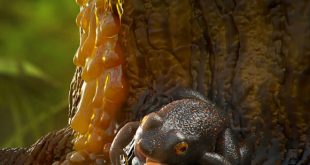
In a paper published this week in the journal Scientific Reports, paleontologists have described an extinct genus and species of frog, Electrorana limoae, preserved in mid-Cretaceous (99 million years old) amber from Myanmar. About 99 million years ago, a tiny juvenile frog in what is today Myanmar was suddenly trapped …
Read More »99-Million-Year-Old Hard Tick Wrapped in Spider Silk Found Encased in Amber
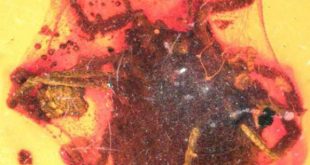
The oldest example of a tick wrapped in spider silk has been found, preserved in Burmese amber. It dates from the Cretaceous period, about 99 million years ago. A unique example of a fossil tick preserved wrapped in a spider web from the Cretaceous Burmese amber; it is the oldest …
Read More »Paleontologists Find Oldest Animal Footprints Ever Discovered
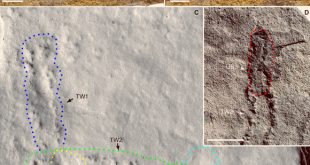
The oldest known animal ‘footprints’ on Earth, left by bilaterian animals with paired appendages about 545 million years ago, have been discovered in the Yangtze Gorges area of South China. Trackways and burrows excavated in situ from the Shibantan Member, Dengying Formation, China: (A and B) epirelief (top bedding surface) …
Read More »Sea Life Recovered Surprisingly Rapidly at Impact Crater of Dino-Killing Asteroid
The Cretaceous/Paleogene mass extinction ended the reign of the dinosaurs and wiped out 76% of species on Earth. It was caused by the impact of an asteroid in the southern Gulf of Mexico approximately 66 million years ago, forming the Chicxulub impact crater. Although the asteroid killed off species, new …
Read More »Paleontologists Find Fossil of Smallest Spinosaurus
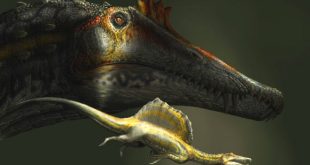
A tiny fossil of an early juvenile Spinosaurus has been discovered by a duo of Italian paleontologists. The largest and the smallest specimens of Spinosaurus known to date. Image credit: D. Bonadonna. Spinosaurus (meaning ‘spine lizard’) was the longest, and among the largest of all known predatory dinosaurs, and possessed …
Read More »Megachirella wachtleri: World’s Oldest Squamate Fossil Found
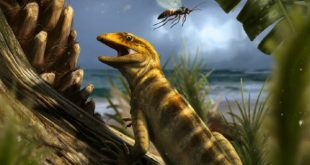
Paleontologists have unearthed the world’s oldest squamate fossil — 240-million-year-old specimen of a species called Megachirella wachtleri — from a site in the Dolomite Mountains, Italy. Megachirella wachtleri. Image credit: Davide Bonadonna. Megachirella wachtleri is the most ancient ancestor of all modern squamates (lizards, snakes and amphisbaenians). The specimen — …
Read More »
#Bizwhiznetwork.com Innovation ΛI |Technology News