October 10, 2021
Paleontogly
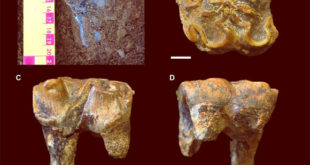
Paleontologists have found a million-year-old hippo tooth at the site of Westbury Cave in Somerset, England. This fossil constitutes the earliest bona fide record of Hippopotamus in the United Kingdom. The left first upper molar of Hippopotamus antiquus from the Early Pleistocene Siliceous Member in Westbury Cave, Somerset, England. Image …
Read More »
October 10, 2021
Paleontogly
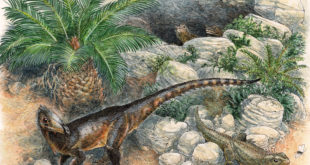
Paleontologists have described a new genus and species of coelophysoid theropod dinosaur from the Late Triassic deposits of Pant-y-ffynnon in southern Wales. Life reconstruction of Pendraig milnerae among the fissures of Pant-y-ffynnon and three individuals of the rhynchocephalian lepidosaur Clevosaurus cambrica during the Late Triassic epoch. Image credit: James Robbins. …
Read More »
October 10, 2021
Paleontogly
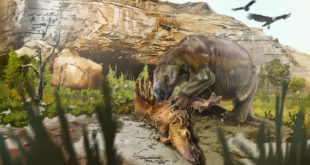
New research published in the journal Scientific Reports provides the first direct evidence of omnivory in an ancient sloth species. Reconstruction of the Darwin’s ground sloth (Mylodon darwinii) feeding on the carcass of the hoofed native herbivore Macrauchenia. These extinct mammals roamed the Pleistocene landscape of Patagonia and other parts …
Read More »
October 10, 2021
Paleontogly
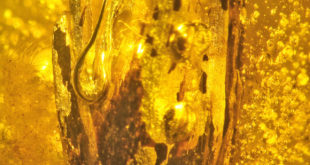
Eograminis balticus, a new species of grass found in a piece of 40-50-million-year-old amber, represents the first definite grass to be described from Baltic amber as well as the first fossil member of Arundinoideae, a subfamily of the widespread Poaceae family that includes cereal grasses, bamboos and many species found …
Read More »
October 2, 2021
Paleontogly
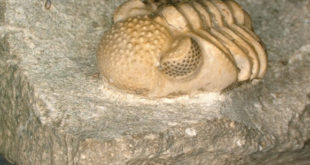
Trilobites are extinct arthropods that dominated the faunas of the Paleozoic Era. Since their appearance 523 million years ago, they were equipped with elaborate compound eyes. While most of them possessed apposition compound eyes, comparable to the compound eyes of many crustaceans and insects living today, trilobites of the suborder …
Read More »
October 2, 2021
Paleontogly
Two new Early Cretaceous specimens from the Wessex Formation of the Isle of Wight, UK, represent distinct and novel genera and species of spinosaurids: Ceratosuchops inferodios and Riparovenator milnerae, according to a team of paleontologists led by the University of Southampton. Artist’s impressions of Ceratosuchops inferodios (foreground) and Riparovenator milnerae …
Read More »
October 2, 2021
Paleontogly
A new genus and species of extinct predatory bird has been identified from a fossilized partial skeleton unearthed in South Australia. Life reconstruction of Archaehierax sylvestris. Image credit: Jacob Blokland / Taylor & Francis Online. The newly-identified bird species lived during the Late Oligocene epoch approximately 25 million years ago. …
Read More »
October 2, 2021
Paleontogly
The newly-discovered dinosaur species, Spicomellus afer, is the earliest-known ankylosaur and the first ankylosaur to be named from Africa. Life reconstruction of the armored dinosaur Borealopelta markmitchelli, which lived in what is now Alberta, Canada, some 110 million years ago, eating ferns. Image credit: Julius Csotonyi / Royal Tyrrell Museum. …
Read More »
September 24, 2021
Paleontogly
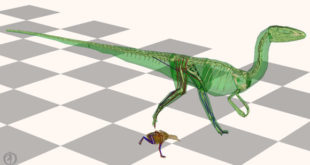
The tail of bipedal non-avian dinosaurs played a role analogous to the swinging arms of humans during walking and running, according to new research led by Harvard University’s Dr. Peter Bishop. Computer simulations of running locomotion in a modern tinamou bird (brown) and the extinct theropod dinosaur Coelophysis (green). Gray …
Read More »
September 24, 2021
Paleontogly
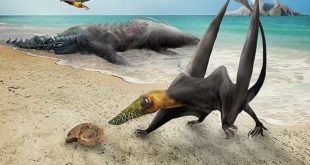
Paleontologists have unearthed and described the fragmentary fossilized remains of a non-pterodactyloid pterosaur in the Atacama Desert in northern Chile. Life reconstruction of a rhamphorhynchine pterosaur from the Cerro Campamento Formation, Chile. Image credit: Universidad de Chile. The newly-described pterosaur inhabited the ancient supercontinent of Gondwana some 160 million years ago …
Read More »
 #Bizwhiznetwork.com Innovation ΛI |Technology News