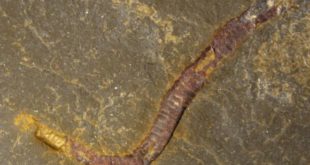
Paleontologists from the University of Missouri have discovered the well-preserved digestive tracts in the fossils of microscopic animals called cloudinomorphs. The worm-like animals lived during the Ediacaran period, some 550 million years ago. The fossilized cloudinomorph Costatubus bibendi from the Wood Canyon Formation, Nye County, Nevada, the United States. Image …
Read More »Two-Species Bacterial Colonies Form Intricate Flower-Like Patterns
In a series of experiments, a team of biologists at the University of California, San Diego studied the structure of growing colonies comprised of two species of rod-shaped bacteria, Escherichia coli and Acinetobacter baylyi; the researchers were surprised to see that the highly-motile Acinetobacter baylyi accelerated the spread of the …
Read More »New Study Sheds Light on Solar System’s Great Divide
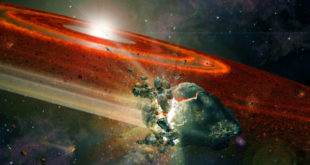
A new study, published in the journal Nature Astronomy, suggests that our young Solar System’s protoplanetary disk was divided into two regions: on the one side were terrestrial planets, such as Earth and Mars, made up of fundamentally different types of materials than the more distant Jovian planets, such as …
Read More »World’s Oldest Slime Mold Found in Amber
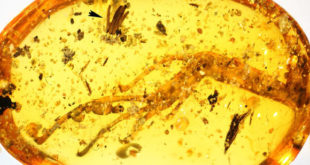
The fossilized fruiting bodies of a myxomycete from the extant genus Stemonitis preserved in Kachin amber date back some 100 million years (mid-Cretaceous period) and represent the oldest record of myxomycetes known to date. Overview of the Kachin amber specimen showing the close proximity of the myxomycete sporocarps (arrowhead) and …
Read More »Scientists Find 7-Billion-Year-Old Stardust in Murchison Meteorite
A team of researchers from the United States, Switzerland and Australia has found 4.6 to 7-billion-year-old presolar grains of silicon carbide (SiC) in the Murchison meteorite, a large C2 chondrite that fell in Australia in 1969. Scanning electron microscope image of the 6.2-billion-year-old grain of silicon carbide from the Murchison …
Read More »Scientists Discover Hundreds of New RNA Viruses in Insects
A team of German researchers has discovered several hundreds of new negative strand RNA viruses and at least 20 viral genera in insects. Phylogeny of negative strand RNA viruses: red dots identify virus orders according to current taxonomy; blue clouds show virus families; selected viral species are identified for orientation. …
Read More »Researchers Discover Ten New Bird Taxa in Indonesia
An international team of ornithologists has discovered five new species and five new subspecies of songbirds on little-explored islands off the northeastern coast of Sulawesi. The Taliabu grasshopper-warbler (Locustella portenta). Image credit: James Eaton / Birdtour Asia. “From November 2013 through January 2014, we conducted a bird-collecting expedition to three …
Read More »Habitual Tea Drinking Reduces Risk of Cardiovascular Disease
Using large prospective cohorts among Chinese adults, a research team led by the Chinese Academy of Medical Sciences and Peking Union Medical College has provided new evidence on the protective role of tea consumption on atherosclerotic cardiovascular disease events and all-cause mortality, especially among those who kept the habit all …
Read More »Scientists Sequence Genome of Indian Cobra
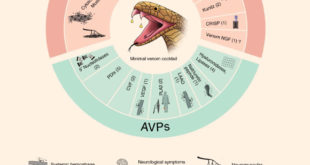
An international team of researchers has sequenced the genome of the Indian cobra (Naja naja), a highly venomous, medically important snake. The Indian cobra (Naja naja). Image credit: Kamal N.V. / CC BY 3.0. Accidental contact with venomous snakes can be deadly. Snakebite envenoming is a serious neglected tropical disease …
Read More »Mars 2020 Rover Completes First Test Drive
NASA has inched closer to completing its next Mars rover with a milestone driving test. The team at NASA’s Jet Propulsion Laboratory in Pasadena, California fired up the Mars 2020 rover and allowed to to drive around the Spacecraft Assembly Facility clean room. NASA reports the rover passed the …
Read More »
#Bizwhiznetwork.com Innovation ΛI |Technology News