December 15, 2020
Archeaology
An analysis of ceramic lipid residues from rural and urban sites of the Indus Civilization in northwest India provides chemical evidence for milk, meat of animals like pigs, cattle, buffalo, sheep and goat, and possible mixtures of products and/or plant consumption. An artist’s reconstruction of the gateway and drain at …
Read More »
December 15, 2020
Biology
Marine biologists working with the Sea Shepherd Conservation Society believe that they have discovered a previously unknown species of beaked whale in the waters north of Mexico’s San Benito Islands. Possibly a new species of beaked whale. Image credit: Simon Ager / Sea Shepherd. A team of researchers on board …
Read More »
December 15, 2020
Space Exploration
Today, Dec. 14, observers along a narrow path in northern Patagonia, crossing Chile and Argentina, will witness one of nature’s most spectacular phenomena: a total eclipse of the Sun. Such an event usually draws travelers from around the world. But because of COVID-19 and its attendant restrictions, few Americans …
Read More »
December 15, 2020
Space Exploration
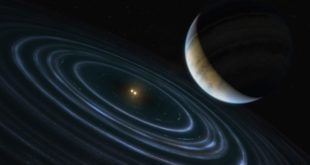
The Hubble Space Telescope has been spying on a very unusual exoplanet some 336 light years away. The planet, known as HD 106906 b, is 11 times the mass of Jupiter, and it orbits the binary stars at a distance of nearly 68 billion miles — 730 times greater …
Read More »
December 15, 2020
Paleontogly
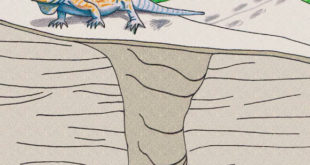
A trace fossil preserved in the Grotto Beach Formation on San Salvador Island, the Bahamas, is the first known fossil example of an iguana nesting burrow. Illustration shows a cross section of the prehistoric iguana burrow, and how the surrounding landscape may have looked during the Late Pleistocene epoch. Image …
Read More »
December 14, 2020
Space Exploration
Non-marine animals (amphibians, reptiles, birds and mammals) have apparently experienced at least 10 distinct episodes of intensified extinctions over the past 300 million years. Eight of these extinction events are concurrent with known marine mass extinctions, which previously yielded evidence for an underlying period of 26.4 to 27.3 million years …
Read More »
December 14, 2020
Archeaology
Using a helicopter-based lidar mapping tool, an international team of scientists led by University of Exeter archaeologists has discovered a network of mound villages in the south-eastern portion of Acre State, Brazil, dating back to 1300-1700 CE. Detail of a circular mound village called Dona Maria with ‘twin’ village. Image …
Read More »
December 14, 2020
Biology
In a paper published this week in the journal PLoS ONE, an international team of researchers described an extraordinary collective defense used by eastern honeybees (Apis cerana) in Vietnam against group-hunting giant hornets Vespa soror: in response to attack by the hornets, eastern honeybee workers foraged for and applied spots …
Read More »
December 14, 2020
Space Exploration
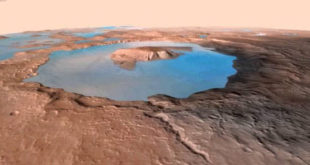
In a new study published in the Planetary Science Journal, a team of U.S. scientists combined experimentally verified data on brine evaporation rates along with a global circulation model to develop a new extensive framework of brine stability on the surface and subsurface of Mars. They found that the equatorial …
Read More »
December 14, 2020
Paleontogly
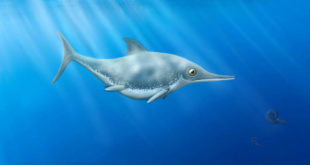
A new genus and species of ophthalmosaurid ichthyosaur that swam in the Late Jurassic seas has been identified from an exceptionally well-preserved specimen found in Dorset, England. An artist’s impression of Thalassodraco etchesi. Image credit: Megan Jacobs. Ichthyosaurs were a successful group of large marine reptiles for most of the …
Read More »
 #Bizwhiznetwork.com Innovation ΛI |Technology News