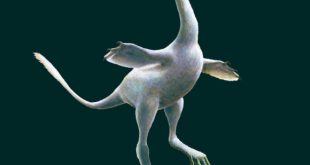
Paleontologists have discovered what they say is a completely unexpected semi-aquatic theropod dinosaur that lived 75 million years ago in what is now Mongolia. An artist’s rendering of Halszkaraptor escuilliei. Image credit: Lukas Panzarin / Andrea Cau. The new dinosaur, named Halszkaraptor escuilliei, is a strange new anomaly in the …
Read More »Study: Microbial Community on International Space Station Resembles Homes on Earth
The microbial community composition on the International Space Station (ISS) is more similar to home surfaces than to the human microbiome samples, according to a new study published in the journal PeerJ. The International Space Station. Image credit: NASA. A team of microbiologists from the University of California, Davis, and …
Read More »Chrysanthemum Genome Sequenced
A team of researchers from the Institute of Chinese Materia Medica, China Academy of Chinese Medical Sciences, and the Amway Botanical Research Center has sequenced the genome of Chrysanthemum indicum (Indian chrysanthemum). The Indian chrysanthemum (Chrysanthemum indicum). Image credit: KENPEI / CC BY-SA 3.0. Chrysanthemums are flowering plants of the …
Read More »Tremendous Black Hole Is the Oldest Ever Discovered
There is still a great deal scientists don’t know about the early universe. Most celestial objects from that era are long gone, and those that still exist from our perspective are extremely distant. That’s why finding ancient quasars is so important. These active supermassive black holes are so bright, we …
Read More »Dog-Sized Marsupial Lion Once Lived in Australia: Wakaleo schouteni
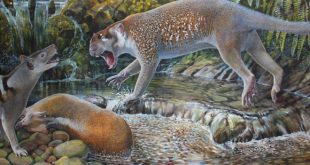
Paleontologists have discovered a new species of carnivorous marsupial lion that lived 26 to 18 million years ago (late Oligocene to early Miocene) in Australia’s rainforests. Reconstruction of Wakaleo schouteni challenging the thylacinid Nimbacinus dicksoni over a kangaroo carcass in the late Oligocene forest at Riversleigh, Australia. Image credit: Peter …
Read More »Research Suggests Martian Clays Formed in Ancient ‘Steam Bath’
On Mars, phyllosilicate (clay) minerals are widespread in terrains that date back to the Noachian period, 4.1 to 3.7 billion years ago. Phyllosilicates are formed by the interaction of water with volcanic rock, leading many planetary researchers to conclude that there must have been sustained surface water, groundwater or active …
Read More »Astronomers Studying ‘Super-Earth’ Exoplanet Find A Bonus Planet
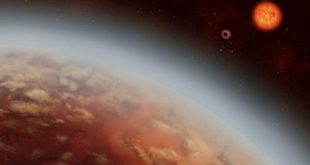
Scientists used to wonder how common planets were throughout the universe, and now we know. They’re extremely common. They’re so common, in fact, it’s possible just to find another one while you’re trying to gather data on the one you already knew about. That’s what happened when astronomers recently turned …
Read More »Plate Tectonics on Europa Could Make Life More Likely
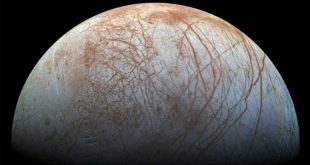
Jupiter’s moon Europa has long been one on of the most enticing potential homes for life in the solar system. Well, other than Earth. While Earth is in the habitable zone with liquid water and a thick atmosphere, Europa is a small frozen moon orbiting a gas giant, However, lurking …
Read More »Pigeons Can Discriminate Abstract Concepts of Space and Time, Study Shows
Pigeons can discriminate the abstract concepts of space and time — and seem to use a different region of the brain than humans and primates to do so, according to new research published in the journal Current Biology. The finding adds to growing recognition in the scientific community that lower-order …
Read More »Gorillas Can Learn to Clean Their Food without Observing Others
Gorillas can spontaneously clean their food before eating it, without first watching another animal to learn from them, an international team of researchers has found. Published in the journal PLoS ONE, the findings challenge the interpretation of recently published data that suggested that gorillas acquire food cleaning primarily by learning …
Read More »
#Bizwhiznetwork.com Innovation ΛI |Technology News