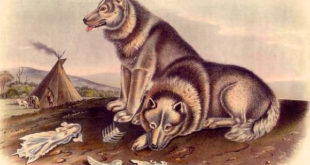
According to a study published in the journal Science, the earliest New World dogs were not domesticated from North American wolves; instead, they form a lineage that likely originated in Eastern Siberia and dispersed into the Americas alongside people. ‘Pre-contact’ American dogs, which arrived alongside people over 10,000 years ago …
Read More »Southeast Asians Derive Ancestry from Four Ancient Populations
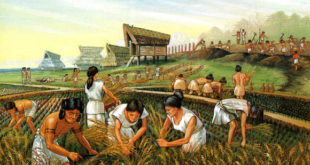
Modern-day Southeast Asian populations are the result of mixing among four ancient populations, including multiple waves of genetic material from more northern East Asian populations, according to researchers who sequenced and analyzed 26 ancient genomes from Southeast Asia and Japan. McColl et al sequenced 26 ancient genomes from Southeast Asia …
Read More »Aquatic Alga Genome Contains Ancient Land Plant Genes
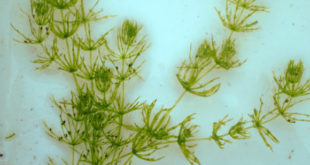
An international team of researchers, led by Kanazawa and Kobe Universities, Japan, and the Universities of Marburg and Freiburg, Germany, has sequenced and analyzed the genome of Chara braunii, a freshwater green alga closely related to land plants. By comparing Chara’s genome to multiple land plant genomes, the scientists were …
Read More »Researchers Identify 1,271 Genetic Variants Linked to Educational Attainment
A multinational team led by researchers at Vrije Universiteit Amsterdam and the Univesities of Queensland and Southern California, Los Angeles, has conducted a large-scale genetic association analysis of educational attainment in a sample of approximately 1.1 million individuals and identified 1,271 genome-wide-significant genetic variants. The findings, published in the journal Nature …
Read More »Flores Pygmies Show No Genetic Link to Mysterious Homo floresiensis
Modern pygmies living in a village near the Liang Bua cave on the Indonesian island of Flores, where fossils of the dwarfed human species Homo floresiensis were discovered in 2004, appears to have evolved short stature independently, according to new research. Reconstruction of Homo floresiensis. Image credit: Elisabeth Daynes. Flores …
Read More »Researchers Sequence Red Fox Genome
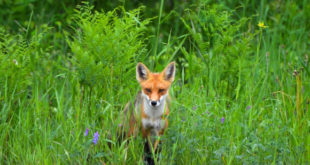
An international team of scientists has successfully sequenced the genome of the red fox (Vulpes vulpes). The red fox (Vulpes vulpes). Image credit: Dia Picard. The domestic dog and the red fox are closely related species that only diverged about 10 million years ago within the family Canidae. However, these …
Read More »Scientists Publish Fully Annotated Reference Genome of Bread Wheat
The International Wheat Genome Sequencing Consortium (IWGSC) published this week the first fully annotated reference genome of the bread wheat (Triticum aestivum), one of the world’s most important crops. Wheat field. Image credit: Pezibear. Wheat is the most widely cultivated crop on Earth, contributing about a fifth of the total …
Read More »Common Ancestor of All Cellular Life on Earth Emerged Very Early in Planet’s History
New research from the Universities of Bristol and Bath suggests life originated on our planet a lot earlier than previously thought. An artistic conception of the early Earth. Image credit: Simone Marchi / NASA. Scientists have long sought to understand ancient life and the shared evolutionary history of life as …
Read More »‘Denisova 11’ Had Neanderthal Mother and Denisovan Father
Neanderthals and Denisovans are extinct groups of hominins that separated from each other more than 390,000 years ago. These two groups inhabited Eurasia — Neanderthals in the west and Denisovans in the east — until they were replaced by modern humans around 40,000 years ago. Now, a research team led …
Read More »Researchers Identify Two Genes that Control REM Sleep
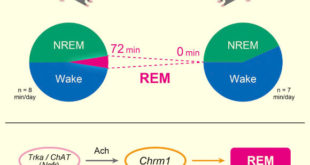
An international group of scientists from Japan and Australia has identified two essential genes involved in the regulation of rapid eye movement (REM) sleep. The acetylcholine pathway has been proposed to be important for wakefulness and REM sleep, but genetic evidence has been missing. Using a knockout of acetylcholine receptor …
Read More »
#Bizwhiznetwork.com Innovation ΛI |Technology News