Physicists from CERN’s Large Hadron Collider beauty (LHCb) experiment have found two never-before-seen particles, as well as hints of another new particle, in high-energy proton collisions. The LHCb magnet. Image credit: CERN. The newly-discovered particles, named Σb(6097)+ and Σb(6097)–, are predicted by the quark model, and belong to the same …
Read More »Sleep Loss Impairs Metabolism, Leads to Adverse Weight Gain, Study Says
Losing just one night of sleep can have a tissue-specific impact on the regulation of gene expression and metabolism, according to new study. The findings, published in the journal Science Advances, may explain how long-term shift work and chronic sleep loss can impair metabolism and adversely affect human body composition. …
Read More »Bee Venom Could Help Treat Atopic Dermatitis
New research, conducted by scientists from Korea and Australia, paves the way for a new treatment for atopic dermatitis, by testing the effect of bee venom and its major component, melittin, on mice and human cells. Hyun-Jin An et al found that bee venom and melittin possess potent anti-atopic activities. …
Read More »New Smartphone App Accurately Measures Blood Pressure from Fingertip
A team of researchers at Michigan State University has developed an iPhone X app that measures blood pressure via the ‘oscillometric finger pressing method.’ Chandrasekhar et al invented a proof-of-concept blood pressure app that can give accurate readings using an iPhone. Image credit: Michigan State University. “By leveraging optical and …
Read More »Study: Daily Fasting Improves Health and Longevity in Male Mice
A new study led by the National Institute on Aging shows that a long daily period of fasting improves the health and survival of male mice, regardless of caloric intake, diet composition, and body weight. Increasing daily fasting times made mice healthier and live longer compared to mice who ate …
Read More »Diclofenac Linked to Increased Cardiovascular Health Risks
A traditional non-steroidal anti-inflammatory drug (NSAID) called diclofenac poses a cardiovascular health risk compared with no use, paracetamol use, and use of other traditional NSAIDs, according to a study led by Aarhus University Hospital researchers. Diclofenac is associated with an increased risk of major cardiovascular events. Image credit: Petr Vnukko. …
Read More »Experimental Vaccine-Adjuvant Combination Eliminates Melanoma in Mice
A team of scientists from the Scripps Research Institute and the University of Texas Southwestern Medical Center has demonstrated that adding an ‘adjuvant’ molecule called diprovocim to a new vaccine can draw cancer-fighting cells to tumor sites. An experimental vaccine that boosts the immune system’s ability to fight cancers could …
Read More »Researchers Create Micromotor Pill
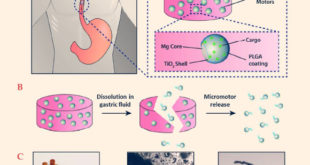
A team of scientists at the University of California, San Diego has found a way to encapsulate micromotors into pills. The pill’s coating protects the devices as they traverse the digestive system prior to releasing their drug cargo. Karshalev et al created a micromotor pill and demonstrated its attractive use …
Read More »Higher Dairy Consumption Reduces Risk of Cardiovascular Disease
According to investigators from the Prospective Urban and Rural Epidemiology (PURE) study, dairy intake of around three standard servings per day is associated with lower risk of cardiovascular disease and mortality, compared to lower levels of consumption. Dairy consumption was associated with lower risk of mortality and major cardiovascular disease …
Read More »Daily Low-Dose Aspirin Has No Effect on Healthy Life Span in Older Adults, Study Shows
According to the findings from the ASPirin in Reducing Events in the Elderly (ASPREE) study, taking a low-dose aspirin daily does not prolong healthy living in older adults. Aspirin is a well-established therapy for the secondary prevention of cardiovascular events. However, its role in the primary prevention of cardiovascular disease …
Read More »
#Bizwhiznetwork.com Innovation ΛI |Technology News