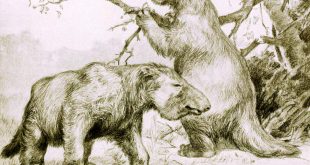
Giant sloths, massive animals that lived in the Americas during the Ice Age, subsisted on an exclusively plant-based diet, according to an isotopic analysis of bones reported in the journal Gondwana Research. Megatherium sloths. Image credit: Robert Bruce Horsfall. Sloths may well rank among the world’s most peculiar animals: with …
Read More »Beibeilong sinensis: Paleontologists Identify New Species of Cassowary-Like Dinosaur
A team of paleontologists from Canada, China, the United States and Slovak Republic has identified a partial clutch of large dinosaur eggs with a closely associated baby dinosaur skeleton as an embryo and eggs of a new, large caenagnathid oviraptorosaur, Beibeilong sinensis. A nesting cassowary-like dinosaur named Beibeilong sinensis in …
Read More »Earliest Signs of Microbial Life on Land Found in 3.48-Billion-Year-Old Hot Spring Deposits
Fossil evidence of early microbial life has been found in ancient hot spring deposits in the Dresser Formation in the Pilbara Craton, Western Australia, that date back approximately 3.48 billion years. A paper reporting this discovery is published in the journal Nature Communications. Spherical bubbles preserved in 3.48 billion-year-old hot …
Read More »45-55 Million Year Old Orchid Pollinaria Attached to Pollinating Insect Found in Piece of Baltic Amber
A new study published in the Botanical Journal of the Linnean Society documents evidence of an orchid fossil trapped in Baltic amber that dates back 45-55 million years ago (Eocene epoch), beating the previous record for an orchid fossil found in Dominican amber some 20-30 million years old. A fungus …
Read More »Galeamopus pabsti: New Species of Long-Necked Dinosaur Identified
A new species of sauropod dinosaur that lived about 152 million years ago (Jurassic period) has been identified from fossils found in Wyoming. Galeamopus pabsti in its environment in the Late Jurassic of North America. An Allosaurus and two Ceratosaurus are feeding on a carcass of Galeamopus pabsti. Image credit: …
Read More »Tokummia katalepsis: Cambrian Marine Predator Had More Than 50 Legs, Can Opener-Like Pincers
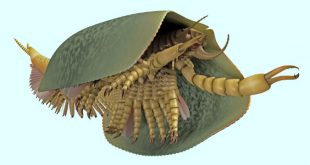
Paleontologists have uncovered a fossil species — named Tokummia katalepsis — that sheds light on the origin of Mandibulata (mandibulates), the most diverse and abundant group of animals, to which belong flies, ants, crayfish and centipedes. Reconstruction of Tokummia katalepsis. Image credit: Lars Fields. Tokummia katalepsis — a large bivalved …
Read More »Sea Scorpions Used Striking ‘Weapon’ to Dispatch Prey, Paleontologists Say
Eurypterids, better known as sea scorpions, used their serrated-spine-tipped tails to dispatch their prey, according to new research by University of Alberta paleontologists Scott Persons and John Acorn. This illustration shows a sea scorpion attacking an early vertebrate. Image credit: Nathan Rogers. Sea scorpions are an extinct group of aquatic …
Read More »Teleocrater rhadinus: Early Dinosaur Relative Had Surprising Crocodile-Like Look
Paleontologists have long wondered what the earliest dinosaur relatives looked like. Most assumed that they would look like dwarf dinosaurs and walk on two legs. The discovery of Teleocrater rhadinus, however, has overturned popular predictions. A reconstruction of Teleocrater rhadinus feasting on a relative of early mammals. Image credit: Mark …
Read More »Blood-Engorged Tick Found in Dominican Amber
A blood-engorged nymphal tick of the genus Amblyomma surrounded by fossilized mammalian erythrocytes (red blood cells) has been discovered in a piece of 15-45-million-year-old amber. The discovery is reported March 20 in the online edition of the Journal of Medical Entomology. This blood-engorged nymphal hard tick Amblyomma sp. (length – …
Read More »AMAZING!! Daspletosaurus horneri: New Tyrannosaur Species Discovered
Paleontologists have unveiled a remarkable new species of tyrannosaurine dinosaur from the Late Cretaceous epoch — a cousin of the fearsome predator Tyrannosaurus rex. Life reconstruction of the integument of Daspletosaurus horneri, based on the distribution of texture on the facial bones. The face in tyrannosaurs was covered by an …
Read More »
#Bizwhiznetwork.com Innovation ΛI |Technology News