Paleontogly

Paleontologists Uncover New Insights into Non-Iridescent Feather Colors in Prehistoric Birds

An international team of paleontologists from the United Kingdom and Germany has shown that blue feather melanosomes are highly distinct from melanosomes that are from feathers expressing black, reddish-brown, brown and iridescent. Reconstruction of Eocoracias brachyptera with hypothesized plumage coloration. Image credit: Marta Zaher, University of Bristol. A pigment called …

Read More »

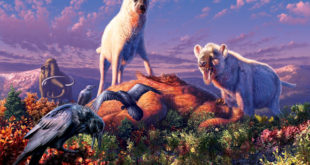
Hyenas Once Lived above Arctic Circle

Paleontologists have found two fossilized teeth of extinct cursorial hyenas (genus Chasmaporthetes) in the remote Old Crow River region in northern Yukon Territory, Canada. An artist’s rendering of ancient Arctic hyenas belonging to the genus Chasmaporthetes. Image credit: Julius T. Csotonyi. The newly-described fossil teeth of Chasmaporthetes hyenas are most …

Read More »

Paleontologists Find Strange Microbes in Dinosaur Fossils

In a new study published in the journal eLife, an international team of paleontologists looked for preserved collagen proteins and DNA in the fossilized bones of a horned dinosaur called Centrosaurus. They didn’t find the proteins or DNA, but they did find unusual communities of modern microbes living inside the …

Read More »

Giant Cambrian Trilobite Species Unearthed in Australia

Paleontologists have unearthed fossils of a giant trilobite species that inhabited Australian waters approximately 500 million years ago (Cambrian period). An artist’s impression of Redlichia rex on the Cambrian seafloor. Image credit: Katrina Kenny. Trilobites are a group of extinct marine arthropods that resemble modern-day horseshoe crabs and are related …

Read More »

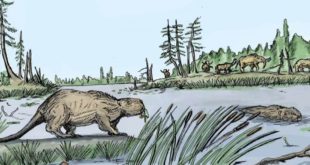
Why Giant Beavers Went Extinct 10,000 Years Ago

Giant beavers (members of the genus Castoroides) inhabited North America throughout the mid- to late Pleistocene. They went extinct along with dozens of other megafaunal species at the end of the last Ice Age, approximately 10,000 years ago. Now a team of researchers in Canada has uncovered a possible reason …

Read More »

Two T. rex Little Cousins Discovered

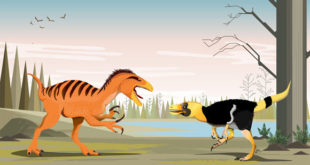
Two new species of predatory megaraptoran dinosaurs have been identified from fossils found in Thailand. Phuwiangvenator yaemniyomi (left) and Vayuraptor nongbualamphuensis. Image credit: Adun Samathi / Rheinische Friedrich-Wilhelms Universität Bonn. The two new species, named Phuwiangvenator yaemniyomi and Vayuraptor nongbualamphuensis, roamed the Earth approximately 125 million years ago (Cretaceous period). …

Read More »

Paleontologists Find One-Billion-Year-Old Fossil Fungi in Canada

An international team of paleontologists has discovered 1,000- to 900-million-year-old microfossils of a fungus in estuarine shale of the Grassy Bay Formation in Arctic Canada. These multicellular organic-walled microfossils are more than half a billion years older than previously reported occurrences of fungi. Microphotograph of Ourasphaira giraldae. Image credit: Loron …

Read More »

99-Million-Year-Old Ammonite Found in Burmese Amber

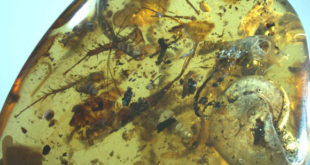
An international team of paleontologists has found a piece of amber containing the beautifully preserved ammonite, several marine and land organisms that lived 99 million years ago (Cretaceous period). The 99-million-year-old piece of amber from northern Myanmar. Image credit: Nanjing Institute of Geology and Palaeontology. The ammonite-bearing piece of amber …

Read More »
Bizwhiznetwork Consultation