September 30, 2020
Paleontogly
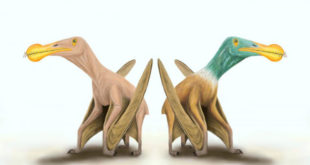
Dr. David Unwin from the University of Leicester and University of Portsmouth’s Professor Dave Martill believe Mesozoic flying reptiles called pterosaurs had a relatively smooth skin without any covering. An artist’s impression of a bald pterosaur and a feathered pterosaur. Image credit: Megan Jacobs, University of Portsmouth. Pterosaurs were Earth’s …
Read More »
September 30, 2020
Biology
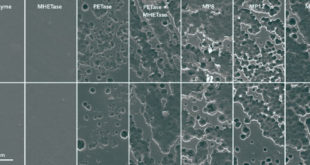
In 2018, University of Portsmouth’s Professor John McGeehan and colleagues engineered an enzyme that can digest polyethylene terephthalate (PET), the primary material used in the manufacture of single-use plastic beverage bottles. Now, the same team has created a two-enzyme cocktail that can digest PET up to six times faster. Knott …
Read More »
September 28, 2020
Paleontogly
Paleontologists in Tasmania have unearthed the fossilized remains of a previously unknown species of the trilobite genus Gravicalymene and named it after Thomas Stewart Baker, the fourth actor to play the title character in the television series ‘Doctor Who.’ Gravicalymene bakeri. Scale bar – 1 cm. Image credit: Smith Ebach. …
Read More »
September 27, 2020
Space Exploration
Humanity spent years wondering if there were planets outside our solar system, and now we know the answer: very much yes. There are thousands of exoplanets in just our little corner of the galaxy, and there’s every reason to expect the same is true of other galaxies. In fact, …
Read More »
September 27, 2020
Archeaology
The 13,000-year-old partial tusk of an adult mammoth found in western Siberia has four images of two-humped camels engraved on it. The 13,000-year-old engraved mammoth tusk from the Tom River, western Siberia. Image credit: Esin et al, doi: 10.1016/j.ara.2020.100180. The engraved tusk was found in 1988 at a locality known …
Read More »
September 26, 2020
Physics
Time travel with free will is logically possible in our Universe without any paradox, according to new research from the University of Queensland. Physicists seek to understand the underlying laws of the Universe. Image credit: Johnson Martin. “Classical dynamics says if you know the state of a system at a …
Read More »
September 25, 2020
Space Exploration
The release of the first-ever image of a real black hole in 2019 was a watershed moment for science, but there’s still more work to do. The Event Horizon Telescope (EHT) team is still planning future observations, but it’s also looking at old data to strengthen our understanding of …
Read More »
September 25, 2020
Biology
A multinational team of scientists led by Harvard Medical School, Brigham and Women’s Hospital, the Wellcome Sanger Institute, Max Delbrück Center for Molecular Medicine and Imperial College London has created a detailed cellular and molecular map of six anatomical adult heart regions. Litviňuková et al created the first atlas of …
Read More »
September 25, 2020
Genetics
A team of researchers from Imperial College London, the University of Oxford and CABI has successfully sequenced the genome of Alexander Fleming’s original fungal strain behind the discovery of penicillin, now classified as Penicillium rubens, and compared it to those of two ‘high producing’ industrial strains of Penicillium rubens and …
Read More »
September 25, 2020
Space Exploration
A significant portion of some of the oldest terrain on Venus, known as tesserae, has striations consistent with layering, according to new research led by North Carolina State University. A simulated view from above Tellus Tessera, one of the regions on Venus where Byrne et al identified the presence of …
Read More »
 #Bizwhiznetwork.com Innovation ΛI |Technology News