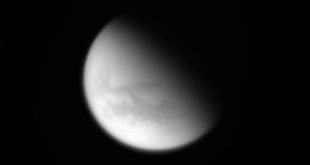
On April 22, 2017, NASA’s Cassini spacecraft made its 127th and final close approach to Titan, passing at an altitude of about 608 miles (979 km) above the moon’s surface. This image of Titan (colorized) was captured by Cassini during its final close flyby of the hazy moon on April …
Read More »Study: Oxygen-Deprived Naked Mole-Rats Turn into ‘Plants’
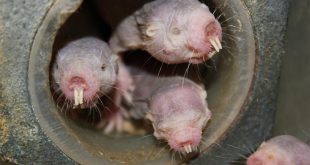
Deprived of oxygen, African naked mole-rats (Heterocephalus glaber) can survive by metabolizing a type of sugar called fructose just as plants do, a new study says. Prof. Gary Lewin holding a naked mole-rat (Heterocephalus glaber). Image credit: Roland Gockel, MDC. The naked mole-rat is a nearly hairless and nearly sightless …
Read More »Solar System’s Heliosphere Much More Compact, Rounded than Previously Thought
Many stars show tails that trail behind them like a comet’s tail, supporting the idea that our own Solar System has one too. However, new evidence from NASA’s Cassini, Voyager and Interstellar Boundary Explorer (IBEX) missions suggests that the trailing end of the Solar System may not be stretched out …
Read More »ESA: Time to Get Serious About Removing Space Junk
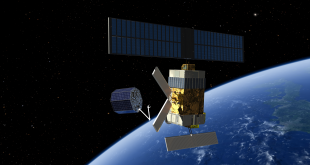
Humanity has been shooting things into space for a few decades now, and we’ve gotten pretty good at it. What we haven’t gotten so good at is bringing things back down. Scientists have been sounding the alarm about the buildup of space junk for years, a point that was reinforced …
Read More »New Cassini Image Shows Earth and Moon between Saturn’s Rings
This view from NASA’s Cassini orbiter shows Earth and its only natural satellite as points of light between the icy rings of the gas giant Saturn. Cassini captured this view of Earth and the Moon on April 12. Image credit: NASA / JPL-Caltech / Space Science Institute. Cassini captured this …
Read More »This Week in Space: Metal on Mars, Hydrogen Inside Enceladus, and a Meteoric Near-Miss
We didn’t get pasted by that asteroid that sailed through Wednesday, which is arguably a good thing. Discovered in 2014, it was due to pass by Earth at a close but safe distance, which it won’t do again for another 500 years. Scientists all over the world took the opportunity …
Read More »Pigeons May Share Human Ability to Build on Work of Others
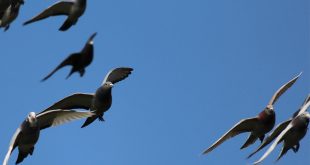
A team of researchers at the University of Oxford’s Department of Zoology has shown that the elements of the capacity of humans to build on the work of others may also be present in homing pigeons (Columba livia). Single flying pigeon. Image credit: Takao Sasaki. The ability to gather, pass …
Read More »Newly Discovered Earth-Like Planet May Have the Right Conditions for Life
With every new exoplanet discovery, we seem to get that much closer to finding evidence of extraterrestrial life. A new exoplanet identified in orbit of a nearby star could be the best place to look yet. Astronomers have confirmed a star 39 light-years away plays host to a planet that …
Read More »Scientists Use CRISPR-Cas9 to Create Red-Eyed Mutant Wasps
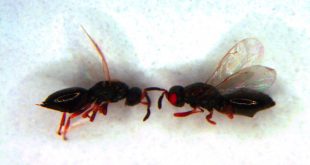
Genetic scientists from the University of California, Riverside, and the W.M. Keck Science Department of Claremont McKenna, Pitzer and Scripps Colleges, have managed to create a strain of red-eyed mutant wasps. Red-eyed Nasonia vitripennis. Image credit: Li et al, doi: 10.1038/s41598-017-00990-3. The red-eyed wasps were created to prove that CRISPR …
Read More »Sea Scorpions Used Striking ‘Weapon’ to Dispatch Prey, Paleontologists Say
Eurypterids, better known as sea scorpions, used their serrated-spine-tipped tails to dispatch their prey, according to new research by University of Alberta paleontologists Scott Persons and John Acorn. This illustration shows a sea scorpion attacking an early vertebrate. Image credit: Nathan Rogers. Sea scorpions are an extinct group of aquatic …
Read More »
#Bizwhiznetwork.com Innovation ΛI |Technology News