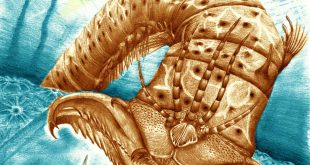
When you’re a small pre-mammalian creature, sometimes the only way to protect yourself against fearsome predators like saber-toothed carnivores is to turn your saliva into a venomous cocktail. That is exactly what a therocephalian therapsid called Euchambersia mirabilis did about 257 million years ago (Permian period) in what is now …
Read More »Triassic Fossil Reveals First Evidence of Live Birth in Archosauromorphs
The first ever evidence of live birth in a group of animals previously thought only to lay eggs has been discovered by an international team of paleontologists from China, the United States, Australia and UK. Artist’s reconstruction of Dinocephalosaurus showing the rough position of the embryo within the mother. Image …
Read More »Ancient Giant Penguin Unearthed in New Zealand
The fossilized leg bones of a giant penguin that lived 61 million years ago have been discovered in New Zealand. Artist’s impression of a group of Waimanu penguins on a beach in Paleocene Canterbury. Image credit: Chris Gaskin, Geology Museum, University of Otago. The fossil was found by amateur fossil …
Read More »105-Million-Year-Old Amber Preserves Pollinating Beetle, Pollen
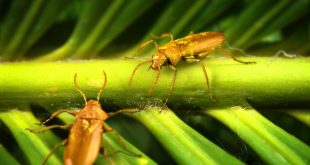
An international team of paleobiologists has uncovered the fossil of a 105-million-year-old gymnosperm pollinating beetle, named Darwinylus marcosi. The fossil, encased in a piece of amber from Spain, is shedding new light on the various ways insects pollinated plants during the mid-Mesozoic era. Reconstruction of Darwinylus marcosi on a gymnosperm …
Read More »World’s Oldest Known Fossils Found in Canada Push Evidence for Life back by 70 Million Years
An international team of paleontologists has discovered in Quebec, Canada, the oldest physical evidence of life on Earth — fossils that date back 3.77 billion years. The discovery was reported online today in the journal Nature. Hematite tubes from the NSB hydrothermal vent deposits that represent the oldest microfossils and …
Read More »Seven New Species of Night Frogs Discovered in India
Seven new species of the genus Nyctibatrachus (Night frogs) have been discovered in the Western Ghats global biodiversity hotspot in India. Seven new species of night frogs from the Western Ghats, India. Image credit: SD Biju. The genus Nyctibatrachus (family Nyctibatrachidae) is endemic to the Western Ghats and represents an …
Read More »Study: Married People Have Lower Levels of Stress Hormone Cortisol
A study led by Carnegie Mellon University researchers provides the first biological evidence to explain how marriage impacts health. According to Brian Chin et al, married people have lower cortisol levels and steeper slopes than the unmarried ones. Image credit: Olessya. Carnegie Mellon University Professor Sheldon Cohen and co-authors found …
Read More »Scientists Identify Brain-Signaling Molecule that Triggers Fat Burning
A research team led by Scripps Research Institute scientist Dr. Supriya Srinivasan has identified a brain hormone that appears to trigger fat burning in the gut. Model depicting the FLP-7/NPR-22 neuroendocrine axis that underlies the 5-HTergic control of body fat loss. In the nervous system, an integrated 5-HT and octopaminergic …
Read More »Geckolepis megalepis: New Gecko Species Has Exceptionally Large, Fish-Like Scales
A bizarre new species of the fish-scale gecko genus Geckolepis has been found living in the ‘tsingy’ karst formations of northern Madagascar. Geckolepis megalepis in life. Image credit: Frank Glaw. The Geckolepis fish-scale geckos are small- to medium sized arboreal and nocturnal lizards endemic to Madagascar and the Comoro Islands. …
Read More »Shortest-Sleeping Mammal? African Elephants Sleep Only Two Hours Per Day
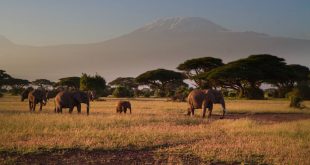
A new study published in the journal PLoS ONE has revealed that wild African elephants (Loxodonta africana) sleep an average of two hours a day and regularly go nearly two days without sleep. African elephants. Image credit: Ro Dobby. African elephants are iconic mammals of the continent and the largest …
Read More »
#Bizwhiznetwork.com Innovation ΛI |Technology News