January 27, 2021
Space Exploration
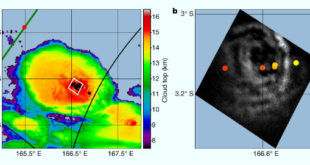
Using the Atmosphere-Space Interactions Monitor (ASIM) observatory on the International Space Station (ISS), researchers have observed five intense blue flashes, one of which initiated a pulsating blue jet into the stratosphere, over the Pacific Ocean, close to the island of Nauru. Blue jet: (a) the cloud-top altitude of the storm …
Read More »
January 27, 2021
Paleontogly
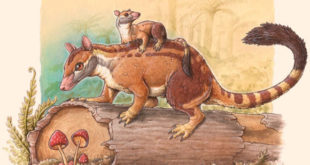
Dr. Laura Chornogubsky, a paleontologist in the Museo Argentino de Ciencias Naturales ‘Bernardino Rivadavia’ and CONICET, has described one new genus and three new species in the marsupial family Polydolopidae. Kramadolops maximus, the youngest known species of polydolopid marsupial. Image credit: Gabriel Lío. Polydolopidae is a family of extinct marsupials …
Read More »
January 25, 2021
Paleontogly
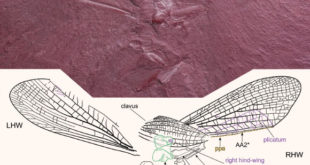
Paleontologists have identified a new fossil genus and species of primitive praying mantis from fore- and hind-wing imprints discovered in Labrador, Canada. Labradormantis guilbaulti. Image credit: Demers-Potvin et al., doi: 10.1111/syen.12457. Paleontologists know that most modern praying mantises, with their characteristic grasping forelegs, look very different from their oldest fossil …
Read More »
January 25, 2021
Biology
Neonicotinoid insecticides, such as imidacloprid, clothianidin, thiamethoxam and thiacloprid, affect the amount of sleep taken by both buff-tailed bumblebees (Bombus terrestris) and fruit flies (Drosophila melanogaster), according to two new studies led by University of Bristol researchers. The buff-tailed bumblebee (Bombus terrestris). Image credit: Myriam. “The neonicotinoids we tested had …
Read More »
January 22, 2021
Paleontogly
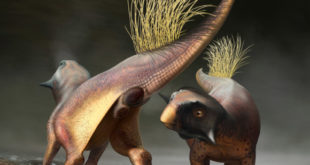
Although paleontologists know now much about dinosaurs and their appearance, they have not known anything about how their cloacal region — the all-purpose opening used for defecation, urination and breeding — appears. Paleontologists from the United Kingdom and the United States have now described the cloacal opening of Psittacosaurus, an …
Read More »
January 22, 2021
Genetics
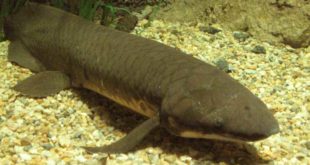
The Australian lungfish (Neoceratodus forsteri), a species of lungfish native to the Mary and Burnett River systems in south-eastern Queensland, has a genome size about 14 times larger than that of humans. The Australian lungfish (Neoceratodus forsteri) at the National Zoo Aquarium in Canberra, Australia. Image credit: Mitch Ames / …
Read More »
January 22, 2021
Paleontogly
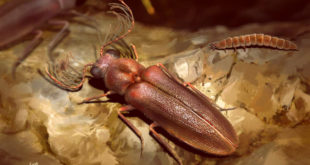
Found in a piece of mid-Cretaceous amber from northern Myanmar, the wonderfully-preserved male of Cretophengodes azari has a light organ on the abdomen which presumably served a defensive function. An artistic reconstruction of Cretophengodes azari; the larviform female in the background is reconstructed based on extant Phengodidae and Rhagophthalmidae beetles. …
Read More »
January 22, 2021
Paleontogly
A new genus and species of caimanine alligatorid being named Chinatichampsus wilsonorum has been discovered by a team of paleontologists from Virginia Tech, the University of Texas at Austin, and the University of Iowa. Holotype of Chinatichampsus wilsonorum: (A) cranium in dorsal view; (B) interpretive line drawing; gray areas indicate …
Read More »
January 22, 2021
Paleontogly
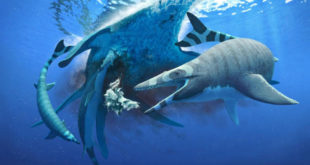
A bizarre new genus and species of mosasaur with teeth unlike those of any known reptile has been identified from fossils found in Morocco. Life reconstruction of Xenodens calminechari. Image credit: Andrey Atuchin. The mosasaurs were a group of lizards that became highly specialized for marine life in the mid-Cretaceous …
Read More »
January 22, 2021
Space Exploration
NASA’s InSight lander has been studying the red planet for more than two years now. During that time, InSight has beamed back data on the planet’s seismic activity, weather, and even the sound of blowing wind. It was also supposed to relay data on the planet’s internal temperature, but …
Read More »
 #Bizwhiznetwork.com Innovation ΛI |Technology News