A team of microbiologists has isolated 105 completely new species of bacteria from healthy people’s intestines. Forster et al created the most comprehensive collection of human intestinal bacteria to date. About 2% of a person’s body weight is due to bacteria and the intestinal microbiome is a major bacterial site …
Read More »Ancient Giant Pandas Had More Complex Diet than Do Their Modern Counterparts: Study
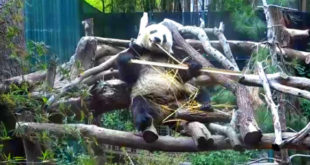
Today, giant pandas are represented by one iconic species, Ailuropoda melanoleuca, and they live only in the understory of particular mountains in southwestern China. They exclusively consume bamboo and have distinctive tooth, skull, and muscle characteristics adapted to a tough and fibrous bamboo diet. But according to new research by …
Read More »Study Sheds Some New Light on Evolution of Bird Beaks
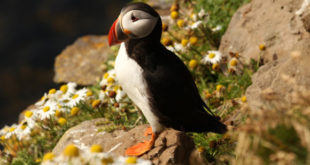
The observation that Galapagos finches possessed different beak shapes to obtain different foods was central to the theory of evolution by natural selection, and it has been assumed that this relationship holds true across all bird species. However, a University of Bristol-led study suggests bird beaks are not as adapted …
Read More »Record-Breaking Salamander Found in Tennessee
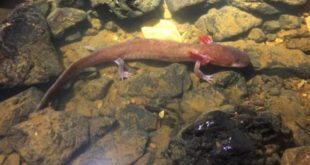
A team of scientists has discovered the largest individual of any cave salamander in North America — a 9.4-inch (23.8 cm) long specimen of the Berry Cave salamander (Gyrinophilus gulolineatus). The largest specimen of the Berry Cave salamander (Gyrinophilus gulolineatus) measures 9.4 inches. Image credit: Nicholas Gladstone / University of …
Read More »Striped Bodypaintings Deter Blood-Sucking Flies: Study
Bodypainting is widespread in African, Australian and Papua New Guinean indigenous communities. Many bodypaintings use white or bright stripes on brown skin. A new study published in the journal Royal Society Open Science shows that these stripes protect skin from insect bites. Reflection-polarization characteristics of the sunlit sticky white-striped brown …
Read More »Powerful Mosquito-Repelling Compounds Isolated from Rare Bacterium
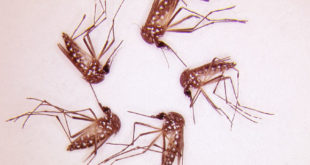
A mixture of mosquito-repelling compounds isolated from a Gram-negative bacterium called Xenorhabdus budapestensis exhibits potent feeding-deterrent activity against three important mosquito species (Aedes aegypti, Anopheles gambiae, and Culex pipiens), and works at lower doses than repellents currently on the market, including DEET and picaridin, according to a study published in …
Read More »New Research Reveals How Facial Tumor Disease Became Transmissible in Tasmanian Devils
The Tasmanian devil (Sarcophilus harrisii), the world’s largest living carnivorous marsupial, is threatened with extinction by a horizontally transmitted cancer termed devil facial tumor disease (DFTD). Using an integrative systems-wide approach, a team of researchers in Austria has identified molecular mechanisms that are crucial for DFTD’s transmissibility. Their results appear …
Read More »Varroa Mites Feed Primarily on Honeybee Fat Body Tissues, Not Hemolymph
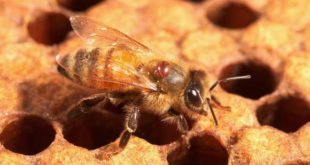
A parasite called the varroa mite (Varroa destructor) is the most serious pest of European honeybees (Apis mellifera) worldwide. For decades, scientists have assumed that varroa mites feed on honeybee hemolymph (blood). But a new study suggests that these parasites instead have a voracious appetite for a honeybee organ called the …
Read More »Bizarre New Species of Treefrog Discovered in Ecuador
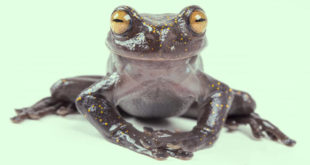
A team of researchers from the Pontificia Universidad Católica del Ecuador has described a new species of treefrog from Cordillera del Condor, a largely unexplored range in the eastern Andes. Hyloscirtus hillisi. Image credit: Gustavo Pazmiño, BIOWEB Ecuador. The newly-discovered treefrog belongs to Hyloscirtus, a genus of 37 species distributed …
Read More »Biologists Unravel Memory Mechanism in Flowering Plants
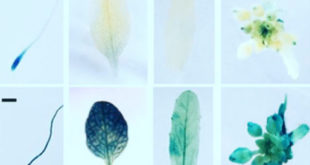
A team of researchers from the United Kingdom and the Netherlands has identified a mechanism that enables angiosperms (flowering plants) to sense and remember changes in their environment. Histochemical staining of Arabidopsis thaliana: (i) 7-day-old seedling primary root tip, (ii) rosette leaf, (iii) cauline leaf and (iv) inflorescence of Col-0 …
Read More »
#Bizwhiznetwork.com Innovation ΛI |Technology News