 #Bizwhiznetwork.com Innovation ΛI |Technology News
In a clinical first, researchers declare to have moved memories in between sea snails by injecting RNA from a skilled sea snail into one that hasn’t been trained – and observing the experienced reaction in the 2nd snail.
The research wasn’t done to produce some sort of mollusc mega-mind, however to assist comprehend the physical basis of memory – and it might aid in both restoring lost memories, and reducing the trauma of painful ones.
The researchers, led by biologist David Glanzman of the University of California, Los Angeles, were intending to understand something called the engram – a physical trace of memory storage.
And RNA is likewise included in the procedure of forming long-term memories. This led Glanzman and his group to the possibilitythat some aspects of long-term memory might be transferred by means of the molecule. To check their hypothesis, they trained sea snails.
This isn’t really as tough as it sounds -they just applied a mild, but still unpleasant, electrical shock to the tails of a sea snail called Aplysia californica. Aplysia californica.(Chad King/NOAA MBNMS/ Wikimedia Commons) The researchers administered 5 electric shocks to the training group of snails, one every 20 minutes. Then, 24 Hr later on, the scientists duplicated the
process. When researchers tapped the snails afterward, those that had actually received the shock training contracted their bodies into a defensive posture for approximately around 50 seconds-
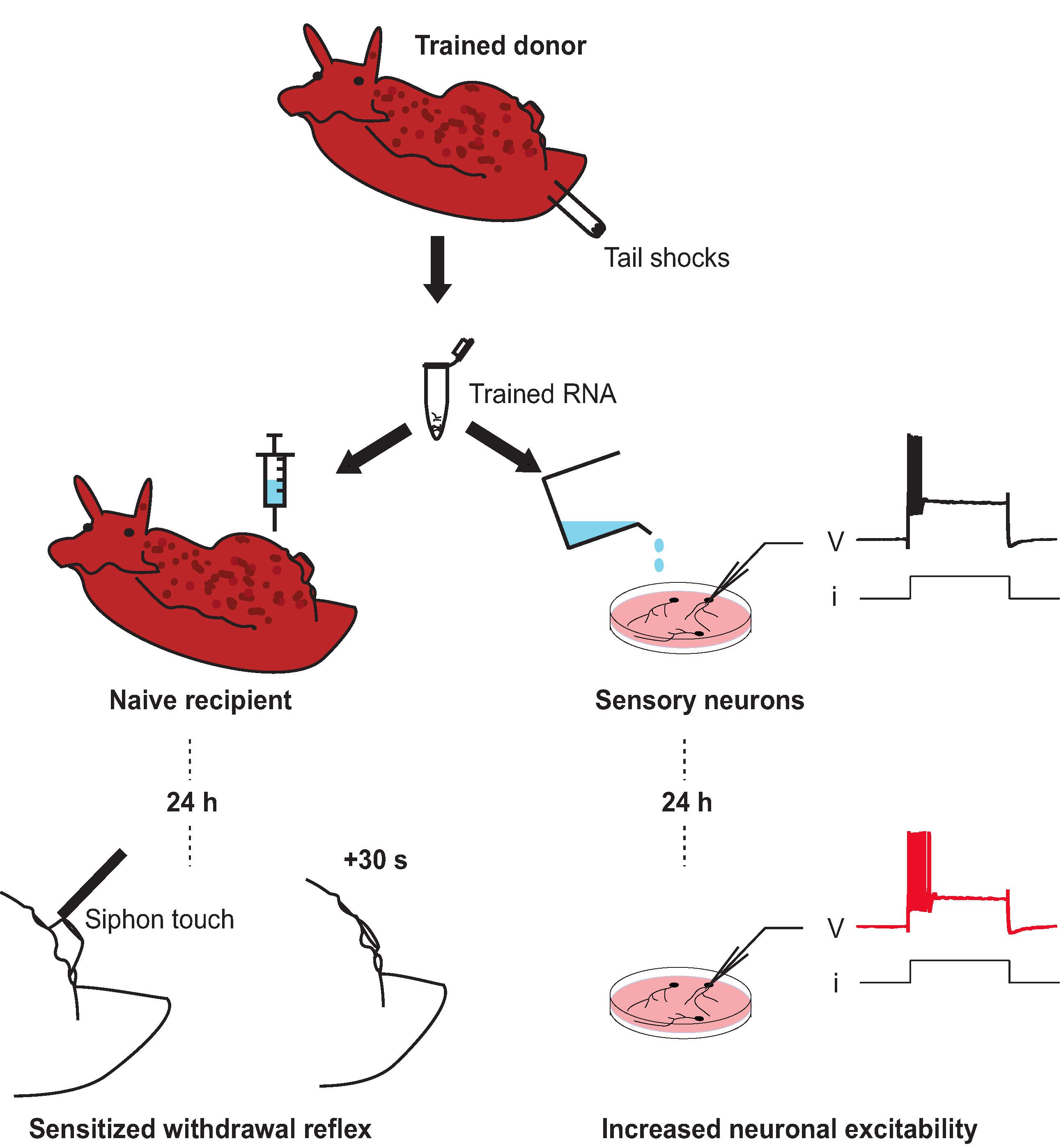
but the snails that had not been trained just contracted for about one second. For the next step, RNA was drawn out from both the qualified and inexperienced snails. The particles were then injected into 2 groups of inexperienced snails. Exactly what occurred next was amazing. The inexperienced snails that had
gotten RNA from the skilled group then reacted to taps as though they had been shocked too- contracting defensively for approximately 40 seconds
. The untrained snails who had received RNA from inexperienced donors did not exhibit any modification in their defensive action. For the next phase of the experiment, the scientists drawn out motor neurons and sensory nerve cells
from untrained snails, putting them in petri dishes either individually or in pairs including one nerve cell of each type.
They then added RNA from trained and untrained snails to these dishes to observe the impact on the neurons. They found that adding the RNA of skilled snails increased excitability in the sensory neurons -an effect that is likewise observed
when, during training, electric shocks are administered to the snails’tails. And, obviously, the RNA of untrained
snails didn’t have this result on the sensory nerve cells. (Bédécarrats et al., eNeuro, 2018 )It’s currently commonly accepted that memory storage is allowed by adjustments to the synapses -the structures
 in the brain that transfer signals between the neurons. However Glanzman believes that they’re actually kept inside the nerve cells themselves -and his experiment shows this possibility.”If memories were saved at synapses, there is no chance our experiment would have worked,” he said. Of course, we’ll require additional
research to validate this possibility. While A. californica is extensively utilized to study neurological procedures since of the way their nerve cells are comparable to ours, exactly what we observe in animal models
cannot constantly be used to humans. And it’s possible that the RNA is transferring some other procedure, not necessarily memory.”It’s intriguing, but I do not believe they have actually transferred a memory, “biochemist Tomás Ryan of Trinity College Dublin, who was not associated with the research study, told The Guardian. “This work informs me that possibly one of the most standard behavioural responses involve some type of switch in the animal and there is something in the soup that Glanzman extracts that is striking that switch.”But if Glanzman is right, his discovery could be a game-changer for those whose lives are adversely affected by memory.” I believe in the not-too-distant future, we might possibly utilize RNA to ameliorate the impacts of Alzheimer’s disease or trauma,” he stated. The research has been published in the journal eNeuro
.
Source
https://www.sciencealert.com/memory-transferred-between-sea-snails-rna-engram