 #Bizwhiznetwork.com Innovation ΛI |Technology News
You’ve heard of “you are what you consume”– this research study shows that for sharks, the more appropriate phrase is “you are where you ate”.
A major international partnership led by the University of Southampton might help global efforts to overturn current declines in the world’s shark population by supplying greater insight into the feeding habits of the world’s most misinterpreted fish.
Led by Dr Christopher Bird during his PhD at Southampton, the study published in Nature Ecology & & Development, utilized chemical markers in the kind of carbon isotopes found in sharks to investigate where in the world they have actually been feeding– an unsolved question for lots of shark species. Knowing which parts of the global ocean are essential shark feeding areas may assist to develop more efficient preservation procedures to safeguard declining shark populations.

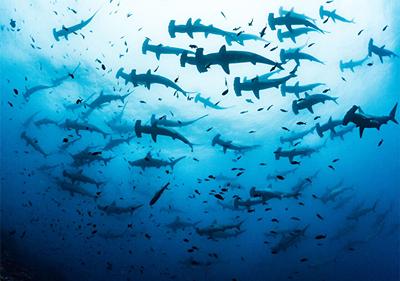
Sharks are certainly among our most varied and misinterpreted group of fish. Credit: Simon Pierce All life depends on carbon at the bottom of the food cycle. Carbon comes in 3 kinds or isotopes, and the proportions of two of the most typical isotopes vary throughout the world’s ocean. In the research study, 73 scientists from 21 nations compared the carbon isotopes from more than 5000 sharks from 114 types around the world with those from phytoplankton at the bottom of the food web.
“If an animal feeds in the same place where it was captured, the carbon isotope signals in the shark and phytoplankton will match,” says Dr Bird whose PhD research study was focused on deep-sea sharks. “Nevertheless, if the shark has moved in between feeding and where it was caught, then the signals will be various.
“You’ve heard of “you are what you consume”– well this is more “you are where you ate”, Dr Bird continued. “We were able to reveal that sharks living near land and those that live in the open ocean have really various methods of feeding.
The outcomes show that sharks living near to the coast feed locally throughout a series of various food webs– this is like individuals living in a city with access to lots of different dining establishments in the neighbourhood and no requirement to travel far to find the food they desire. On the other hand, oceanic sharks that are found throughout the world’s oceans, appear to obtain many of their food from particular areas of cooler water in the northern and southern hemispheres. This is more like travelling long distances from backwoods to invest lots of time consuming in a few dining establishments in a remote city.
“With over 500 recognized species around the world, sharks are definitely among our most diverse and misunderstood group of fish however we still have actually restricted knowledge of their habits and behaviours, particularly relating to feeding and movement,” stated Dr Bird. “Over the last 50 years, the pressures of fishing and environment destruction have actually led to declines among some of the world’s shark populations, the effects which are likewise not completely understood.”
Senior author Dr Clive Trueman, Partner Professor in Marine Ecology also from the University of Southampton included, “The outcomes have important ramifications for preservation. Internationally, sharks are refraining from doing well. Many shark populations have decreased in the last few decades, especially in the extensive oceanic sharks that are targeted by fishing boats and captured mistakenly in tuna fisheries as “by-catch”. Governments are now developing big marine safeguarded areas around the globe, which assist to decrease fishing, however the majority of these safeguarded locations are in tropical waters, and might not offer reliable defense for oceanic sharks.”
“Sharks urgently need our assistance, however to assist them we likewise require to understand them. Our research study has actually helped by determining essential shark feeding premises. New technologies like satellite and isotope tracking are providing us the details we need to turn the tide on these gorgeous and interesting animals.”
Source: University of Southampton
Source
https://www.technology.org/2018/01/22/global-analysis-reveals-how-sharks-travel-the-oceans-to-find-food/