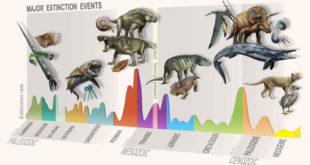
The Carnian Pluvial Episode, a major climate change event that occurred around 234 to 232 million years ago (Late Triassic epoch), was a time of global environmental changes and possibly substantial volcanism. A new analysis of paleontological data suggests that this event was a major — but previously neglected — …
Read More »Wood Boring Trace Fossil
A team of paleontologists from the University of Alberta has found the fossilized tracks of a marine wood-boring organism that lived approximately 110 million years ago (Cretaceous period). Apectoichnus lignummasticans. Image credit: Melnyk et al, doi: 10.1017/jpa.2020.63. Trace fossils are biologically produced sedimentary structures that include tracks, trails, burrows, borings, …
Read More »Preserved Embryo
Paleontologists recently found well-preserved dinosaur eggs in an enormous nesting ground of titanosaurian sauropod dinosaurs that lived about 80 million years ago (Cretaceous period) in what is now Patagonia, Argentina. In a paper in the journal Current Biology, they now describe an almost intact embryonic skull from one of these …
Read More »Triassic Mammal Relative
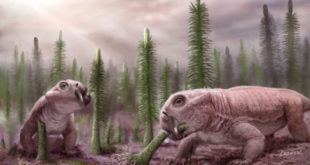
In a paper published in the journal Communications Biology, a team of U.S. paleontologists reports evidence of a hibernation-like condition in Lystrosaurus, an early relative of mammals that lived between 253 and 248 million years ago (Early Triassic epoch). The discovery was enabled by high-resolution of incremental growth marks preserved …
Read More »Carboniferous Period Fish
Paleontologists Redescribe Enigmatic Period Fish A team of U.S. paleontologists has redescribed the morphology of a long-snouted ray-finned fish called Tanyrhinichthys mcallisteri and created a more complete and accurate reconstruction of the fish as a living animal. Tanyrhinichthys mcallisteri was most likely a bottom-cruising predator similar in general ecomorphology to …
Read More »Antarctica Marine Reptile
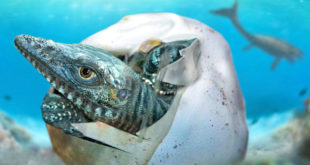
Paleontologists Find Giant Soft-Shelled Egg of Cretaceous-Period Marine Reptile in Antarctica A giant fossilized egg of an extinct marine reptile has been found in the 68-million-year-old nearshore marine deposits in Antarctica. An artist’s rendering of a pair of mosasaurs and their egg. Image credit: Francisco Hueichaleo. Named Antarcticoolithus bradyi, the …
Read More »Beibeilong sinensis: Paleontologists Identify New Species of Cassowary-Like Dinosaur
A team of paleontologists from Canada, China, the United States and Slovak Republic has identified a partial clutch of large dinosaur eggs with a closely associated baby dinosaur skeleton as an embryo and eggs of a new, large caenagnathid oviraptorosaur, Beibeilong sinensis. A nesting cassowary-like dinosaur named Beibeilong sinensis in …
Read More »Sea Scorpions Used Striking ‘Weapon’ to Dispatch Prey, Paleontologists Say
Eurypterids, better known as sea scorpions, used their serrated-spine-tipped tails to dispatch their prey, according to new research by University of Alberta paleontologists Scott Persons and John Acorn. This illustration shows a sea scorpion attacking an early vertebrate. Image credit: Nathan Rogers. Sea scorpions are an extinct group of aquatic …
Read More »Paleontologists Redraw Dinosaur Family Tree
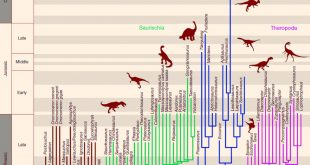
A team of paleontologists from the University of Cambridge and the Natural History Museum, London, UK, has proposed radical changes to the dinosaur family tree, based on their careful analysis of dozens of fossil skeletons and tens of thousands of anatomical characters. The research by Baron et al provides important …
Read More »Paleontologists Find 450-Million-Year-Old Fossilized Trilobite Eggs
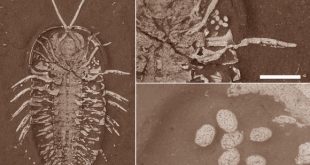
A research team led by Western Illinois University scientist Thomas Hegna has announced the discovery of two pyritized, egg-bearing specimens of the Ordovician trilobite Triarthrus eatoni. Left: ventrally preserved specimen of the Ordovician trilobite Triarthrus eatoni showing nine eggs in the specimen’s left genal angle; scale bar – 5 mm. …
Read More »
#Bizwhiznetwork.com Innovation ΛI |Technology News