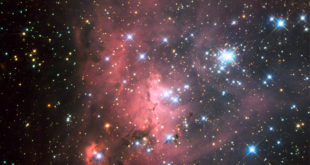
The James Webb Space Telescope is the most powerful telescope astronomers have at their disposal, but that’s not just because it’s got a big mirror (which it does). Webb’s instruments can see far into the infrared, allowing the observatory to see through clouds of dust and gas to observe the …
Read More »New Hubble Discovery
There is no longer any doubt that the universe is teeming with planets — NASA recently announced that the total number of known exoplanets has crossed 5,000, and we’ve only just begun our search of the heavens. Upcoming projects leveraging the shiny new James Webb Space Telescope will certainly …
Read More »Einstein Ring Formation
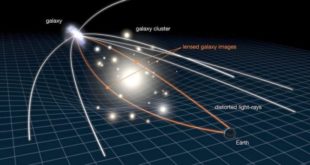
The universe can be a confusing place. Even simple things like arithmetic can fail you when extreme physics come into play. Case in point, the latest image release from the revived Hubble Space Telescope. Astronomers have used the orbiting observatory to capture a rare Einstein Ring. You might think there …
Read More »Stunning New Model Simulates Star Formation in Highest-Ever Resolution
Star formation is the first step on the cosmological road to life as we know it, but understanding the process of star formation is incredibly difficult. The process takes millions of years, so we can only learn so much from scouring the heavens, and simulating it requires hugely complex replicas. …
Read More »Dark Matter Could Solve the Mystery of Supermassive Black Hole Formation
New cosmological research from the University of California Riverside connects two of the universe’s most perplexing phenomena: supermassive black holes and dark matter. According to physicist and astronomer Hai-Bo Yu, dark matter could be the key to understanding how enormous black holes formed in the early universe. This work is …
Read More »Self-Interacting Dark Matter
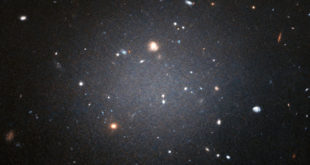
The so-called self-interacting dark matter theory helps explain why NGC 1052-DF2 and NGC 1052-DF4, a pair of ultra-diffuse galaxies located approximately 65 million light-years away the constellation of Cetus, contain little dark matter. The NASA/ESA Hubble Space Telescope took this image of NGC 1052-DF2 on November 16, 2017. Image credit: …
Read More »
#Bizwhiznetwork.com Innovation ΛI |Technology News