September 12, 2021
Paleontogly
Dental cavities or caries is a common disease among modern humans, affecting almost every adult. New research shows that Microsyops latidens, a species of stem primate from the Early Eocene epoch, had a high prevalence of dental caries (7.48% of individuals), with notable variation through time, reaching 17.24% of individuals …
Read More »
August 17, 2021
Paleontogly
Until now, the first fossil evidence of land plants was from the Devonian period (420 million years ago). However, molecular evidence suggests an earlier origin in the Cambrian period. In a new paper in the journal Science, paleontologists described an assemblage of spore-like microfossils from Early Ordivician (480 million years …
Read More »
July 30, 2021
Sports
Once the Earth was fully formed about 4.5 billion years ago, its subsequent evolution was governed by complex geophysical processes. The planet, however, was not in isolation from the rest of the Solar System, and these processes were strongly affected by interplanetary collisions for hundreds of million years. Planetary scientists …
Read More »
March 6, 2021
Paleontogly
The so-called Mount Holly mammoth (Mammuthus sp.) lived approximately 12,800 years ago in what is now New England, a region comprising six states in the Northeastern United States, and potentially overlapped with the first human settlers of the region, according to new research from Dartmouth College. The woolly mammoth (Mammuthus …
Read More »
February 26, 2021
Genetics
Scientists have extracted and sequenced mitochondrial DNA from a partial femur of an ancient dog that lived in Alaska 10,150 years ago. Their results, published in the Proceedings of the Royal Society B, demonstrate that the animal belonged to a lineage of dogs that diverged from Siberian dogs around 16,700 …
Read More »
January 14, 2021
Paleontogly
Paleontologists have described the first three-dimensional preservation of soft tissue in Namacalathus hermanastes, a skeletal metazoan (multicellular animal) that lived some 547 million years ago (Ediacaran period) in what is now Namibia, and established a strong evolutionary link between Ediacaran and early Cambrian metazoans. Namacalathus (individuals numbered). Centimeter scale. Image …
Read More »
December 23, 2020
Space Exploration
Every asteroid that falls to Earth is a potential window into the origins of the solar system, but scientists have stumbled upon something quite strange when studying a fragment of the Almahata Sitta asteroid. It contains evidence of a huge, previously unknown object in our solar system — perhaps …
Read More »
December 20, 2020
Paleontogly
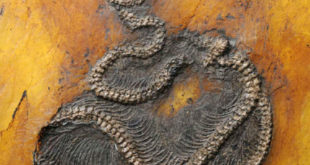
A new genus and species of medium-sized python that lived during the early-middle Eocene period has been identified from several nearly complete skeletons and partial skulls found in Germany. Messelopython freyi. Image credit: Senckenberg Research Institute. The newly-identified python species lived in what is now Germany, approximately 47.6 million years …
Read More »
December 1, 2020
Paleontogly
Paleontologists in Argentina have identified a new species of eusauropod (true sauropod) dinosaur that lived 179 million years ago, just after the mysterious disappearance of non-eusauropod sauropodomorphs. Life reconstruction of Bagualia alba. Image credit: Jorge González. The newly-identified dinosaur lived in what is now Patagonia, Argentina during the Early Jurassic …
Read More »
October 16, 2020
Space Exploration
Solar storms strip a planet’s atmosphere over time, and only a strong magnetosphere would be able to provide maximum protection. Lunar samples gathered by NASA’s Apollo missions recently revealed that the Moon had its own global magnetosphere, lasting from about 4.25 to 2.5 billion years ago. According to new research, …
Read More »
 #Bizwhiznetwork.com Innovation ΛI |Technology News