 #Bizwhiznetwork.com Innovation ΛI |Technology News
When imaging objects in space, distance isn’t the only challenge: Earth’s atmosphere gets in the way, too. As turbulence ripples through our planet’s protective layer, images of stars, the Moon, and even other galaxies become fuzzy and distorted. Correcting these flaws requires adaptive optics, or AO, a technique that uses …
Read More »Solar Eclipse on Mars
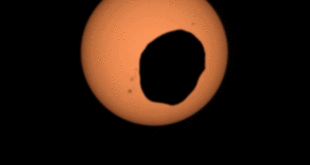
NASA’s Perseverance rover has captured a spectacular video of an April solar eclipse on Mars. The video clearly depicts Phobos as it eclipses the sun, as seen from the Martian surface. “You can see details in the shape of Phobos’ shadow, like ridges and bumps on the moon’s landscape,” said …
Read More »First Glimpse of Venus

According to NASA, the Parker Solar Probe has taken the first images ever taken of Venus’ surface from orbit in visible light. While we’ve imaged the surface with other types of instruments, visible light hasn’t been available from orbit due to the thick cloud cover swirling over the planet. The …
Read More »Helium Ion Microscope

New images of the SARS-CoV-2 coronavirus demonstrate the potential of the helium ion microscopy in bioimaging, especially for the imaging of interactions between viruses and their host organisms. This helium ion microscope image shows SARS-CoV-2 virus particles (blue). Image credit: N. Frese / Bielefeld University. Helium ion microscopy offers the …
Read More »SARS-CoV-2-Infected Cells

A researcher at the University of North Carolina School of Medicine has generated scanning electron microscopy images showing startlingly high SARS-CoV-2 viral loads on human bronchial epithelial cells. This SEM image shows SARS-CoV-2 virions (red) produced by human airway epithelia. Image credit: Camille Ehre, doi: 10.1056/NEJMicm2023328. Dr. Camille Ehre from …
Read More »Odyssey Thermal Images

Mars Odyssey Captures New Thermal Images of Phobos Astronomers using the Thermal Emission Imaging System (THEMIS) camera on NASA’s Mars Odyssey orbiter have captured new infrared images of Phobos, the larger and inner of the two natural Martian satellites. These images from the THEMIS camera on NASA’s Mars Odyssey orbiter …
Read More »Cassini Captures Another Stunning View of Saturn’s Frozen Moon Enceladus

NASA’s Cassini spacecraft currently orbiting Saturn has captured a breathtaking new image of Enceladus, the sixth-largest of the gas giant’s moons. NASA’s Cassini spacecraft returned a breathtaking image of Saturn’s icy moon Enceladus. This view looks toward the anti-Saturn hemisphere of Enceladus. North on Enceladus is up and rotated 4 …
Read More »Cassini Captures Stunning View of Enceladus

NASA has released a new image of Enceladus, the sixth-largest of Saturn’s moons, taken by the agency’s Cassini orbiter. NASA’s Cassini robotic orbiter obtained this image of Saturn’s moon Enceladus on November 27, 2016. This view looks toward the Saturn-facing hemisphere of the moon. North on Enceladus is up and …
Read More »Cassini Captures Close-Up View of Saturn’s Intriguing F Ring
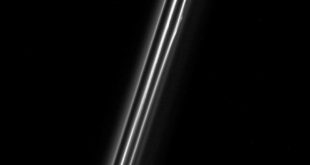
When seen up close, Saturn’s F ring — the outermost discrete ring of the gas giant — resolves into multiple dusty strands. This Cassini view shows four dusty strands of Saturn’s F ring: the central strand is the core of the ring; the other strands are not independent at all, …
Read More »NOAA’s GOES-16 Weather Satellite Captures Its First Images of Earth
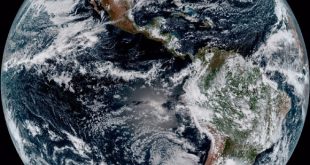
NOAA’s GOES-16 (formerly known as GOES-R), the first spacecraft in a new series of NASA-built advanced geostationary weather satellites, has sent the first high-resolution images from its Advanced Baseline Imager. This composite color full-disk visible image of the Western Hemisphere was captured from NOAA’s GOES-16 satellite on Jan. 15, 2017. …
Read More »