Archaeologists have unearthed the well-preserved remains of a 2,700-year-old wine press at the Phoenician site of Tell el-Burak, 9 km south of Sidon in present-day Lebanon. The wine press at Tell el-Burak from the south-west. Image credit: Tell el-Burak Archaeological Project. The ruins of Tell el-Burak, a small Phoenician settlement …
Read More »Canaanite Palace
The Canaanite palatial site of Tel Kabri in Israel was severely damaged by a large earthquake around 1700 BCE, which led to its abandonment soon thereafter, according to new research by archaeologists from the University of Haifa and George Washington University. The 3,700-year-old ruins of the wine cellar unearthed at …
Read More »Canaanite Fortress
Archaeologists from the Israel Antiquities Authority (IAA) have uncovered the ruins of a 3,200-year-old Canaanite fortress near Gal On, a kibbutz in central Israel. An aerial photo of the Canaanite fortress near Gal On in central Israel. Image credit: Emil Aladjem, Israel Antiquities Authority. “The fortress we found provides a …
Read More »Arabia Stone Monuments
An international team of archaeologists has found and studied 104 enigmatic stone structures called ‘mustatils’ in the southern part of the Nefud Desert in northern Arabia. They’ve also provided the first chronometric age estimate for this type of structure — a radiocarbon date of 5000 BCE — and described their landscape …
Read More »South African Cave
An international team of archaeologists reports the discovery of grass bedding used to create comfortable areas for sleeping and working by Paleolithic humans who lived in South Africa’s Border Cave at least 200,000 years ago. Vertical field section of 43,000-year-old bedding grass from Border Cave, South Africa. Scale bar – …
Read More »Shell Llama & Gold Foil
Archaeologists from the Pennsylvania State University and the Université libre de Bruxelles have found a stone offering box near a reef close to the north-eastern shore of Lake Titicaca, which is located in the Andes between Bolivia and Peru. The carved stone box contained a llama carved from a Spondylus …
Read More »Source of Stonehenge’s
Archaeologists Pinpoint Source of Stonehenge’s Sarsen Megaliths A team of researchers from the UK and South Africa has discovered that most of the hulking sandstone boulders — called sarsens — that make up the famous Stonehenge monument appear to share a common origin 25 km (15.5 miles) away in West …
Read More »Old Leather Toy Mouse
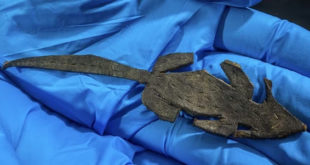
Archaeologists have found a toy mouse at the site of Vindolanda, an ancient Roman military fort and settlement on Hadrian’s Wall in Northumberland, northern England. The 1,900-year-old leather toy mouse from the Roman fort of Vindolanda. Image credit: Vindolanda Trust. The toy mouse measures 12.2 cm (4.8 inches) long and …
Read More »Archaeologists Confirm Site of Genghis Khan’s Winter Base Camp
Archaeologists Confirm Site of Genghis Khan’s Winter Base Camp Avraga, a Mongol Empire site located in an open steppe environment along the Avraga River in east-central Mongolia, was the winter base camp (ordū) of Genghis Khan, according to new research from the Australian National University and the Mongolian Institute of …
Read More »A Non-Tobacco Plant
Archaeologists Find Traces of Non-Tobacco Plant in Pre-Columbian Native American Pipe The 1,430-year-old basalt pipe from central Washington State, the United States, not only contained nicotine, but also had strong evidence for the smoking of the Indian tobacco (Nicotiana quadrivalvis) and the smooth sumac (Rhus glabra). Until now, the use …
Read More »
#Bizwhiznetwork.com Innovation ΛI |Technology News