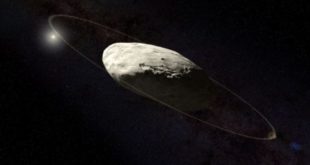
The dwarf planet Haumea orbits the sun in the deep, dark reaches of the outer solar system. Astronomers spotted this object in 2004, and it helped usher in the formal definition a “dwarf planet,” resulting in the demotion of Pluto. The longer astronomers observe Haumea, the more interesting it …
Read More »Scientists Have Spotted One of the Rarest Objects in the Universe
When astronomers peer up at the heavens, they aren’t just looking for objects we already know to exist. They also hunt for evidence of physical phenomena we think should exist but haven’t found yet. When you add up the various factors in play — the vastness of space, the …
Read More »Scientists Might Have an Explanation for Pluto’s Subsurface Ocean
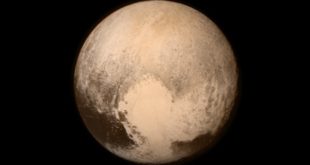
We had no idea what Pluto looked like until 2015 when the New Horizons spacecraft completed its flyby. It’s safe at this point to say that the former planet is a much more complex object than anyone dared expect. It has clouds, fields of nitrogen ice, and (surprisingly) a …
Read More »Study Sheds New Light on Origin of Libyan Desert Glass
Libyan desert glass is a natural glass found in western Egypt that formed 29 million years ago, however its origin is disputed: the two main formation hypotheses include melting by meteorite impact or melting by a large atmospheric airburst. A new study by a duo of researchers from Australia and …
Read More »Ultima Thule: Surprises in Science Results from New Horizons Mission
After flying past the dwarf planet Pluto in 2015, NASA’s New Horizons spacecraft shifted course to Ultima Thule (also known as 2014 MU69), a much smaller body about 22 miles (36 km) in length. Ultima Thule is part of the Kuiper Belt, a torus-shaped ensemble of objects in the outer …
Read More »Mars Reconnaissance Orbiter Completes 60,000 Loops around Red Planet
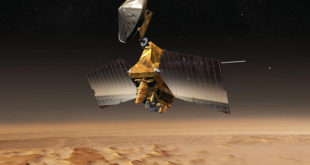
NASA’s Mars Reconnaissance Orbiter (MRO) has been in the Martian orbit for 13 years, and just completed 60,000 trips around the planet. An artist’s concept of NASA’s Mars Reconnaissance Orbiter. Image credit: NASA. Since entering orbit on March 10, 2006, MRO has been collecting daily science about the planet’s surface …
Read More »Small, Rocky Planets Are Most Likely to Survive the Death of a Star
Stars are not forever, although they have lifetimes measured in millions of billions of years. When they finally reach the end of their life, most of the planets that have called a solar system home will be blasted to pieces or ejected into deep space. New research from the …
Read More »NASA Spots Remains of Beresheet Spacecraft on the Moon
Beresheet was supposed to be the first privately built spacecraft to land on the moon, and it technically succeeded in that task. The probe, built by Israel-based SpaceIL, lost contact with Earth during its landing on April 11, resulting in a crash landing. NASA’s Lunar Reconnaissance Orbiter (LRO) passed …
Read More »SpaceX Delays Starlink Launch Again to Update Satellite Software
SpaceX hoped to have 60 custom communication satellites in orbit today, but instead, it has zero. The private spaceflight company scrubbed the first attempted launch of its Starlink internet satellites on Wednesday this week, and now a second launch has been aborted. It’s not mother nature’s fault, though. SpaceX …
Read More »Moon is Still Tectonically Active, Researchers Say
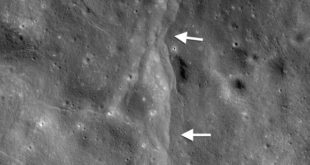
In 2010, an analysis of images from NASA’s Lunar Reconnaissance Orbiter (LRO) found that the Moon shriveled like a raisin as its interior cooled, leaving behind thousands of cliffs called thrust faults on the lunar surface. A new analysis of archival data from seismometers deployed during Apollo missions gives the …
Read More »
#Bizwhiznetwork.com Innovation ΛI |Technology News