October 30, 2017
Space Exploration
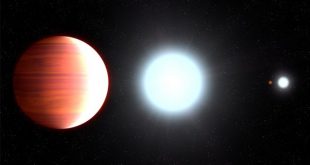
Precipitation on Earth can be a mild inconvenience, but it’s part of the ecosystem that makes our planet habitable. Some much less pleasant substances fall from the sky on other planets and moons. For example, it rains sulfuric acid on Venus and liquid methane on Titan. NASA has just detected …
Read More »
October 30, 2017
Space Exploration
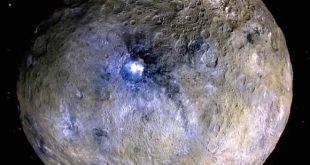
Ceres’ crust, with its mixture of ice, salts and hydrated materials, represents most of the dwarf planet’s ancient ocean, according to two new studies from NASA’s Dawn mission. This false-color image shows the dwarf planet Ceres. Image credit: NASA / JPL-Caltech / UCLA / MPS / DLR / IDA. The …
Read More »
October 26, 2017
Space Exploration
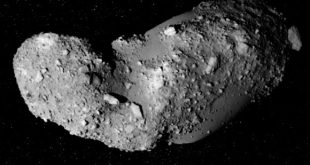
New research has shed light on the collisional history of one of the most famous asteroids. Itokawa’s curious, varied terrain and lack of impact craters indicate it is a rubble pile asteroid. Image credit: Japan Aerospace Exploration Agency. Asteroid 25143 Itokawa is a near-Earth, rubble-pile asteroid, measuring 535 m x …
Read More »
October 25, 2017
Space Exploration
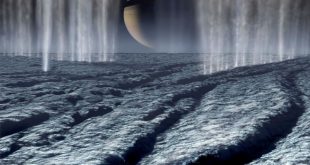
Weathered organic material once dissolved in Enceladus’ subsurface ocean is coating Saturn’s inner moons, explaining surprising variations in their surface colour and UV absorption. This is according to a new analysis that could provide a way to investigate the makeup of our solar system’s most likely watery home to alien …
Read More »
October 24, 2017
Space Exploration
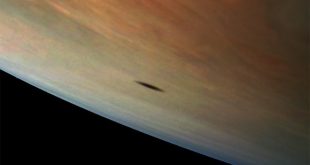
On September 1, 2017, NASA’s Juno spacecraft witnessed a remarkable cosmic event — a small Jovian moon called Amalthea blocked the sunlight and cast a shadow on the face of the gas giant. Amalthea casts a shadow on Jupiter in this image captured by NASA’s Juno spacecraft; the elongated shape …
Read More »
October 23, 2017
Space Exploration
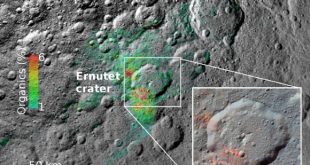
Organic-rich materials found on Ceres by NASA’s Dawn orbiter are native to the dwarf planet, according to new research led by Southwest Research Institute planetary researcher Simone Marchi. Dawn data show a region around Ceres’ Ernutet crater where organic concentrations have been discovered; the color coding shows the surface concentration …
Read More »
October 22, 2017
Business, Space Exploration
A typical day in the workplacefor a planetary defense officer isn’t this exciting.20 th Century Fox NASA is working with a planetary protection officer with a salary of up to $187,000. The job was developed after the signing of the Outer Space Treaty of 1967. Planetary security officers are …
Read More »
October 21, 2017
Space Exploration
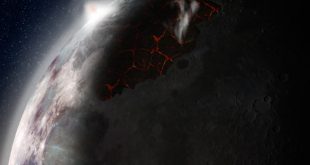
About 3.5 billion years ago volcanic activity on Earth’s only permanent natural satellite produced an atmosphere 1.5 times thicker than is currently on Mars, according to new research published in the journal Earth and Planetary Science Letters. Volcanic activity 3.5 billion years ago released 1019 g of volatiles around the …
Read More »
October 21, 2017
Space Exploration
Black holes are some of the strangest and most interesting things found in deep space. They are items of severe density, with such strong gravitational attraction that even light can not get away from their grasp if it comes near enough. Albert Einstein first predicted black holes in 1916 with …
Read More »
October 20, 2017
Space Exploration
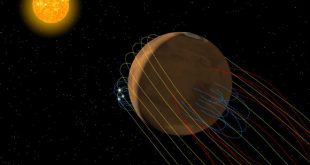
According to new research using data from NASA’s Mars Atmosphere and Volatile Evolution Mission (MAVEN) spacecraft, the Red Planet has an invisible magnetic tail — or magnetotail — that is twisted by interaction with the solar wind. Artist’s conception of the complex magnetic field environment at Mars. Yellow lines represent …
Read More »
 #Bizwhiznetwork.com Innovation ΛI |Technology News