For years, the conventional wisdom was that Mars existed as little more than a cold, barren dust ball in space. The idea that it once supported life was considered unlikely. But then we started sending probes the the Red Planet, and more recently rovers like Curiosity. Since its arrival in …
Read More »Saturn’s Rings Could Have Formed when Dinosaurs Walked the Earth
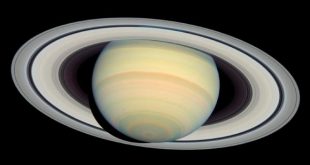
Saturn’s rings are billions of years younger than we thought, say Cornell University researchers analyzing an almost forgotten set of data, collected 10 years ago by NASA’s Cassini mission. This image is a view from the NASA/ESA Hubble Space Telescope taken on March 22, 2004. Camera exposures in four filters …
Read More »Curiosity Finds Odd-Looking Iron-Nickel Meteorite on Mars
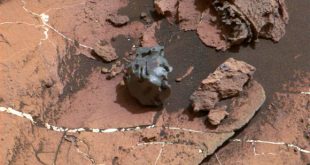
A small globular object found by NASA’s Curiosity rover at the Murray Formation of lower Mount Sharp on Mars has been identified as an iron-nickel meteorite. The smooth-surfaced rock at the center of this Oct. 30 image from Curiosity’s Mast Camera was examined by the rover’s ChemCam instrument and confirmed …
Read More »Concentrically-Fractured Depression on Mars Could Be Place to Look for Signs of Microbial Life
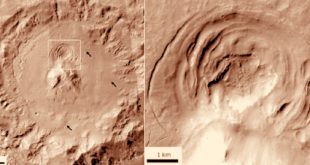
An unusual depression in the northern Hellas basin on Mars could be a new place to look for life on the planet, says a team of planetary researchers. The depression was probably formed by a volcano beneath a glacier and could have been a warm environment well suited for microbial …
Read More »New HiRISE Image Shows Schiaparelli Crash Site in Color
The latest image from the High Resolution Imaging Science Experiment (HiRISE) camera on NASA’s Mars Reconnaissance Orbiter shows parts of ESA’s ExoMars Schiaparelli lander and its crash site in color. On November 1, HiRISE camera on NASA’s Mars Reconnaissance Orbiter observed the impact site of Schiaparelli lander, gaining the first …
Read More »New Horizons Data Suggest Viscous Ocean Lies beneath Pluto’s Heart-Shaped Region
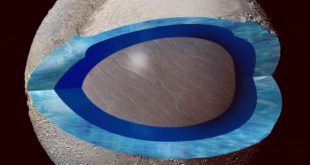
A cold, slushy ocean lying deep beneath Pluto’s bright, heart-shaped Tombaugh Regio is the best explanation for features revealed by NASA’s New Horizons probe, according to new research. This cutaway image of Pluto shows a section through the area of Sputnik Planitia, with dark blue representing a subsurface ocean and …
Read More »Saturn’s North Polar Region Revealed
New near-infrared images of Saturn from NASA’s Cassini spacecraft show the northern polar region including the hexagon and polar vortex. The north polar region of Saturn is pictured in great detail in this Cassini image obtained on July 16, 2016 from a range of one million miles (2 million km). …
Read More »Ice-Quake Echoes Could Lift Lid on Oceans within Pluto and Europa
Measuring outer solar system ice-quakes could identify if Europa’s subsurface ocean is an oxygen-rich, leading candidates for life, or uncover the origin of Enceladus’ giant water plumes, says a team from NASA’s Jet Propulsion Laboratory. They propose that cryo-seismology techniques could also ‘explore’ Pluto’s own newly predicted subsurface sea. Artist’s …
Read More »Planetary Researchers Spot ‘Great Valley’ on Mercury
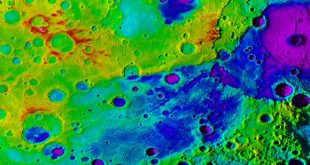
Using images from NASA’s MErcury Surface, Space ENvironment, GEochemistry and Ranging (MESSENGER) spacecraft, planetary researchers have discovered a broad valley in the southern hemisphere of the planet Mercury. Using colorized topography, Mercury’s ‘great valley’ (dark blue) and Rembrandt impact basin (purple, upper right) are revealed in this high-resolution digital elevation …
Read More »Dawn Snaps New Images of Ceres’ Occator Crater
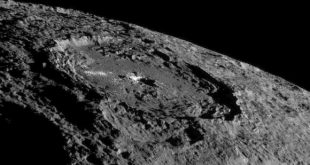
NASA’s Dawn spacecraft has captured another series of photos in its fifth orbit of the dwarf planet Ceres. This image of the limb of Ceres shows a section of the northern hemisphere. Prominently featured is Occator Crater. Dawn took this image on Oct. 17, 2016, at a distance of about …
Read More »
#Bizwhiznetwork.com Innovation ΛI |Technology News