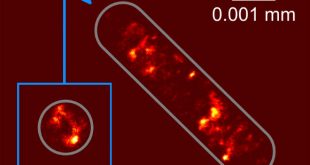
Physicists in Germany have developed a novel technique for trapping biological cells with a laser beam. Using this technique, the researchers obtained super-resolution images of chromosomal DNA within E. coli cells. Picture of the distribution of the genetic information in an E. coli cell. Image credit: University of Bielefeld. “One …
Read More »2016 Gets Longer with Extra Second Added to New Year Countdown
This New Year’s countdown will be one second longer as the National Physical Laboratory — the UK’s national measurement institute and the birthplace of atomic time — introduces the 27th leap second into UTC. The additional second will keep the timescale based on atomic clocks in sync with time based …
Read More »CERN Physicists Observe Light Spectrum of Antimatter for the First Time
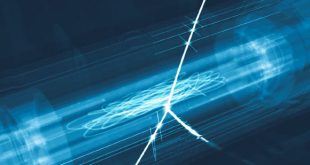
Physicists from CERN’s ALPHA experiment today report the first ever measurement on the optical spectrum of an antimatter atom. Artist’s impression of a cloud of trapped antihydrogen atoms. Image credit: Chukman So. “Using a laser to observe a transition in antihydrogen and comparing it to hydrogen to see if they …
Read More »Nihonium, Tennessine, Oganesson, Moscovium: Four New Chemical Elements Get Names
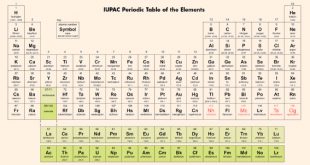
Nihonium (Nh), moscovium (Mc), tennessine (Ts) and oganesson (Og) are the new names of chemical elements 113, 115, 117 and 118 on the periodic table. Periodic table of the elements. Image credit: International Union of Pure and Applied Chemistry / Sci-News.com. “It is a pleasure to see that specific places …
Read More »Physicists Give Schrödinger’s Cat Second Box
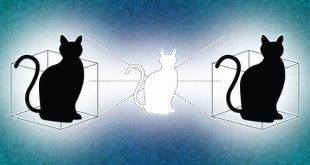
Through new experiments involving the Schrödinger’s cat state paradox, physicists at Yale University have shown that the famous cat can be in two separate locations at the same time. Chen Wang and co-authors have given Schrödinger’s cat a second box to play in. Image credit: Michael S. Helfenbein / Yale …
Read More »Physicists Identify Second Gravitational-Wave Event
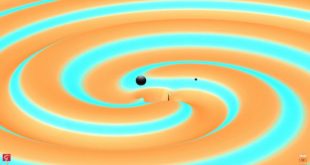
An international team of scientists has identified a second gravitational wave event in the data from the twin detectors of the Laser Interferometer Gravitational-Wave Observatory (LIGO). This image depicts two black holes just moments before they collided and merged with each other, releasing energy in the form of gravitational waves. …
Read More »CERN Physicists Observe Three New Tetraquark Particles
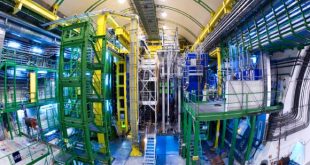
Physicists on CERN’s LHCb collaboration say they’ve observed three new exotic particles – X(4274), X(4500) and X(4700) – and also confirmed the existence of a fourth one, X(4140). According to the scientists, each of these particles contains two quarks and two antiquarks. View of the LHCb detector. Image credit: CERN. …
Read More »Gas Giant Planets May Contain Layers of ‘Dark Hydrogen,’ Say Physicists
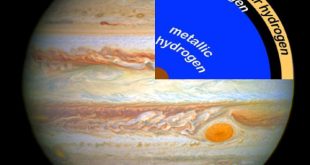
On the surface of giant gaseous planets, hydrogen is a gas. But between this gaseous layer and the liquid metal hydrogen in the planet’s core lies a layer of dark hydrogen, says a team of physicists led by Dr. Alexander Goncharov from Carnegie Institution of Washington and University of Edinburgh …
Read More »Pauli Exclusion: Physicists Directly Observe Key Principle of Quantum Mechanics
An international team of scientists, led by Dr. Niels Kjærgaard from the University of Otago in Dunedin, New Zealand, has used steerable ‘optical tweezers’ to split ultracold clouds of potassium-40 (40K) atoms and smash them together to directly observe a key principle of quantum mechanics – the Pauli exclusion principle. …
Read More »Physicists Shed New Light on How Neutrinos Behave
Physicists from the NOvA collaboration have announced a new result that could improve our understanding of the behavior of neutrinos. NOvA detector. Image credit: Louise Suter / NOvA Collaboration. Neutrinos are tiny, nearly massless subatomic particles that travel at near-light speed. They have previously been detected in three types, called …
Read More »
#Bizwhiznetwork.com Innovation ΛI |Technology News