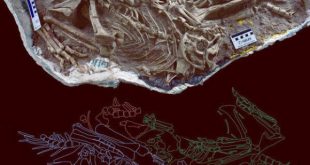
The 70-million-year-old fossilized remains of three juvenile oviraptorids from the Nemegt Formation of Southern Mongolia are the first evidence of ‘communal roosting’ in dinosaurs, according to University of Alberta paleontologist Gregory Funston and colleagues. Photo and sketch of the confiscated specimen showing three different juveniles of the same species of …
Read More »Research Sheds New Light on Biology of Extinct Cave Bear
According to new research from the University of Zürich, the cave bear (Ursus spelaeus) — one of the biggest bear species in history — had an unusually small brain relative to its body size. Reconstruction of the cave bear (Ursus spelaeus). Image credit: Sergio de la Larosa / CC BY-SA …
Read More »Antarctic Plesiosaur Filtered Food Like Modern Baleen Whales
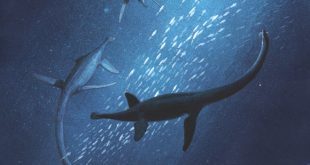
In 1984, Texas Tech University paleontologists Sankar Chatterjee and Bryan Small unearthed the fossilized skull of a previously unknown marine reptile on Seymour Island in Antarctica. While it was obviously a plesiosaur, Morturneria seymourensis was unlike any previously found. Now, three decades later, Professor Chatterjee and colleagues have made a …
Read More »New Ostrich-Like Dinosaur Discovered in Mongolia: Aepyornithomimus tugrikinensis
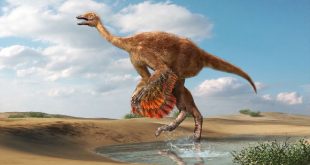
Paleontologists have found fossil fragments from a new species of ornithomimosaur (ostrich-mimic dinosaur) that walked the Earth between 84 and 72 million years ago. Aepyornithomimus tugrikinensis. Image credit: Masato Hattori. Called Aepyornithomimus tugrikinensis, the new dinosaur is a type of ornithomimosaur (Ornithomimidae), a group of theropods that evolved a toothless …
Read More »Archaic Whales were Ferocious Predators, New Research Shows
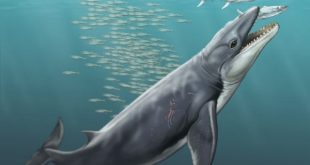
The teeth of archaic whales were as sharp as those of terrestrial predators, and thus were capable of capturing and processing prey, according to new research published in the journal Biology Letters. Reconstruction of the ancient toothed whale Janjucetus. Image credit: Carl Buell. “Contrary to what many people thought, it …
Read More »Meet Lagenanectes richterae, One of Oldest Known Elasmosaurs
In a study published Friday in the Journal of Vertebrate Paleontology, paleontologists report the discovery of a partially-preserved skeleton of one of the earliest known elasmosaurs, from the Early Cretaceous (130 million years ago) of Germany. Life reconstruction of Lagenanectes richterae. Image credit: Joschua Knuppe. Elasmosaurs (Elasmosauridae) were a family …
Read More »Shingopana songwensis: New Titanosaur Species Discovered in Tanzania
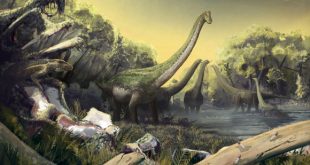
A new species of long-necked titanosaurian dinosaur has been unearthed in southwestern Tanzania. Life reconstruction of Shingopana songwensis. Image credit: Mark Witton, www.markwitton.com. The newly-discovered titanosaur is called Shingopana songwensis and lived between 100 and 70 million years ago (Cretaceous period). A partial skeleton of the prehistoric creature was first …
Read More »Toothless Dwarf Dolphin Provides Insights into Cetacean Evolution
A new species of extinct dwarf dolphin that lived about 30 million years ago (Oligocene epoch) and possessed adaptations for suction feeding has been identified from a fossil found in the Wando River in Charleston, South Carolina. A rendering of Inermorostrum xenops. Image credit: Robert Boessenecker. Named Inermorostrum xenops, the …
Read More »Dino-Killing Chicxulub Asteroid Inhibited Photosynthesis, Cooled Earth for Up To Four Years
A team of researchers from the National Center for Atmospheric Research, the University of Colorado Boulder and NASA has used a world-class computer model to paint a rich picture of how Earth’s conditions might have looked during the K-Pg extinction. This painting depicts an asteroid slamming into tropical, shallow seas …
Read More »Cat-Sized Marsupial Relative Lived in Turkey 43 Million Years Ago
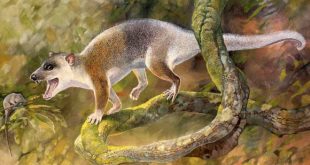
Fossils discovered in Turkey represent a new species that is a previously unknown relative of modern-day marsupials, according to a new paper published in the journal PLoS ONE. An artist’s reconstruction of Anatoliadelphys maasae. Image credit: Peter Schouten. Named Anatoliadelphys maasae, the new species is an unusual, cat-sized carnivorous metatherian …
Read More »
#Bizwhiznetwork.com Innovation ΛI |Technology News