Approximately 2.6 million years ago (Pliocene epoch), a tsunami of cosmic energy from a massive supernova or a series of them about 150 light-years away reached Earth and pummeled the atmosphere, touching off climate change and triggering the mass extinction of large marine animals, according to University of Kansas Professor …
Read More »End-Permian Marine Mass Extinction Caused by Increased Temperatures, Oxygen Loss: Study
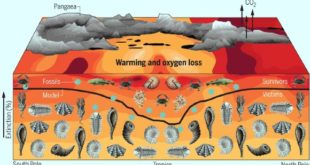
Some 252 million years ago, intense volcanic activity belched massive volumes of greenhouse gasses into the atmosphere and triggered rapid changes to the climate, which resulted in the end-Permian mass extinction, the largest mass extinction event in Earth’s history. Nearly 96% of all marine species were wiped out during the …
Read More »Early Jurassic Ichthyosaur Was Warm-Blooded, Had Blubber and Camouflage, Well-Preserved Soft Tissues Show
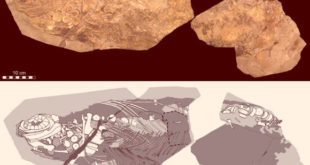
An international team of paleontologists has found the exceptionally preserved remains of a Stenopterygius ichthyosaur that lived 180 million years ago (Early Jurassic epoch). The fossil is so well-preserved that its soft-tissues retain some of their original flexibility. Molecular and microstructural analyses of the fossil have revealed that this creature …
Read More »New Dinosaur Species Discovered in Australia: Weewarrasaurus pobeni
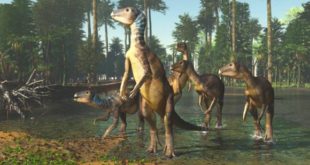
Paleontologists in Australia have found a fossil fragment from a new species of ornithopod dinosaur that walked the Earth approximately 100 million years ago (Cretaceous period). An artist’s impression of Weewarrasaurus pobeni. Image credit: James Kuether. The new Australian dinosaur, named Weewarrasaurus pobeni, was about the size of a large …
Read More »Oligocene-Epoch Whale Had Neither Teeth Nor Hair-Like Baleen
A team of U.S. paleontologists has described a remarkable new species of whale that lived about 33 million years ago (Oligocene epoch). The researchers found that this toothless whale, named Maiabalaena nesbittae, had no baleen, showing a surprising intermediary step between the baleen whales that live today and their toothed …
Read More »Giant Siberian Rhinoceros Lived alongside Early Modern Humans
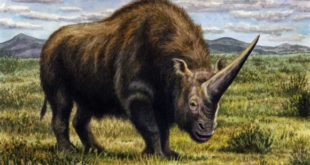
For a long time it was believed that a giant rhinoceros called Elasmotherium sibericum went extinct around 200,000 years ago — well before the Quaternary megafaunal extinction event, which saw the end of the woolly mammoth, Irish elk and saber-toothed cat. Now improved dating of fossils suggests that the species survived …
Read More »Elephant-Sized Dicynodont from Triassic Period Discovered: Lisowicia bojani
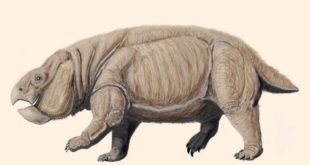
Paleontologists in Poland have found fossil fragments from a giant new species of mammal-like reptile that walked the Earth approximately 237 million years ago (Late Triassic epoch). Lisowicia bojani. Image credit: Dmitry Bogdanov / CC BY 3.0. Named Lisowicia bojani, the ancient creature belongs to Dicynodontia (dicynodonts), a group of …
Read More »New Species of Long-Necked Dinosaur Discovered
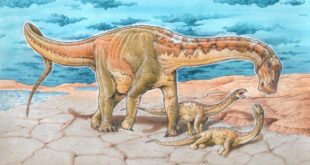
A new species of sauropod dinosaur that stretched 39 feet (12 m) from head to tail has been unearthed in Patagonia, Argentina. Lavocatisaurus agrioensis. Image credit: Canudo et al, doi: 10.4202/app.00524.2018. Dubbed Lavocatisaurus agrioensis, the new dinosaur is thought to have lived approximately 110 million years ago (Cretaceous period). The …
Read More »Mirarce eatoni: Newly-Discovered Cretaceous Bird Lived Among Dinosaurs, Was Strong Flier
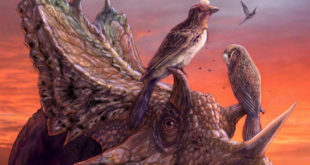
Paleontologists have unearthed the partial skeleton of an enantiornithine (opposite bird) that lived in what is now Utah approximately 75 million years ago (Late Cretaceous epoch). According to an analysis of the fossil, published in the journal PeerJ, Late Cretaceous enantiornithines were the aerodynamic equals of the ancestors of today’s …
Read More »Geologists Find 310-Million-Year-Old Reptile Footprints in Grand Canyon National Park
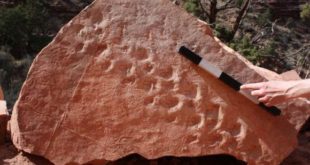
Geologists have discovered a set of 28 footprints left behind by an ancient reptile approximately 310 million years ago in what is now Grand Canyon National Park. Geologists Professor Stephen Rowland and Dr. Mario Caputo discovered that a set of 28 footprints left behind by a reptile 310 million years …
Read More »
#Bizwhiznetwork.com Innovation ΛI |Technology News