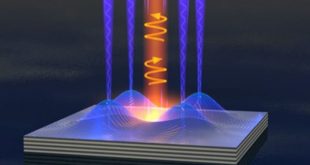
Strange things go on when you push physics to extremes. Extending Moore’s Law to its physical conclusion, we run into problems like the traces in circuits being so small that electrons can quantum tunnel between them. But electrons aren’t the only thing we can use to carry data through circuits. …
Read More »Astronomers observed a nova explosion for the first time by accident
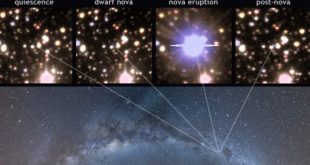
For the first time, a team of scientists have captured all phases of a classical nova explosion — before, during, and after the event. The event took place back in 2009, but at first the astronomers didn’t even realize they’d captured such an unusual occurrence. After going back and looking …
Read More »The Large Hadron Collider is running out of disk space
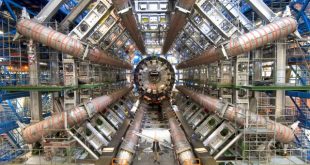
The Large Hadron Collider (LHC) has run into an unanticipated problem — it’s running out of disk space. “This year the LHC is stable and reliable,” says Jorg Wenninger, head of operations at the LHC. “It is working like clockwork. We don’t have much downtime.” That’s actually the problem. When …
Read More »Scientists develop a memristor that can be conditioned just like a real synapse
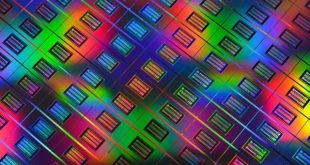
An international collaboration of researchers from UMass Amherst, HP, and the Air Force have built a proof-of-concept memristor that could lead to real-world neuromorphic chips. The memristor is made of a silicon-oxygen-nitrogen material laced with clumps of silver nanoparticles at the electrical terminals. When current is applied across the memristor, the silver nanoparticles shuffle around …
Read More »The 2016 Nobel Prize in Physics goes to mathematicians working in Flatland
The 2016 Nobel Prize in Physics has been awarded to David J. Thouless, Duncan Haldane and J. Michael Kosterlitz for “theoretical discoveries of topological phase transitions and topological phases of matter.” Their work represents a set of mathematical insights about exotic phases of matter like superfluids and superconductors, but it …
Read More »Oxford scientists call into question the idea that the universe’s expansion is accelerating
Type Ia supernovae are affectionately called “standard candles” in astronomy. They’re blessedly predictable, so we use them to measure distances. The 2011 Nobel Prize in Physics went to three astronomers who used standard candles to reach the same conclusion based on the same data: namely, that the universe is expanding …
Read More »LIGO’s black hole detection survives the gravastar test
Ever since the historic discovery of gravitational waves by the Laser Interferometry Gravitational wave Observatory (LIGO), scientists have been trying to amend and refine that data. The original idea was that the first confirmed detection of gravitational waves was the result of a binary black hole event: two black holes …
Read More »Habitable alien planets may be less common than previously believed
If there’s one modern astronomical concept that has successfully permeated the mainstream media, it’s the “Goldilocks zone.” Not only is it associated with the search for alien life, one of the more popular topics in science, it’s also broadly evocative and easy to understand. To host life, a planet can’t …
Read More »Scientists invent a new kind of nanoscale imaging for living cells
Biology is messy, and this is a problem for imaging science. Living things are squishy and porous. They tend to be bathed in fluid. They also move, and all that motion makes it practically impossible to get good high-resolution images of cells and what’s inside them. The best we’ve had to …
Read More »Surgeon plans first human head transplant in 2017
Modern medical technology has granted doctors the ability to transplant many of the body’s organs, extending the life of people suffering from chronic diseases. But what about replacing all the organs at once along with the body they are in? That’s science fiction right now, but Italian neurosurgeon Sergio Canavero …
Read More »
#Bizwhiznetwork.com Innovation ΛI |Technology News