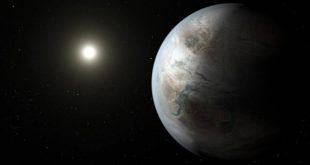
NASA’s Kepler satellite has confirmed once and for all that planets are not a rarity in the universe. In more than eight years in space, the observatory has detected more than 2,000 confirmed exoplanets in orbit of other stars, and now you can add more to the list. A review …
Read More »Mars Reconnaissance Orbiter in Standby Mode After Battery Malfunction
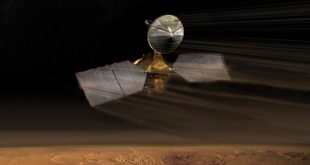
The Mars Reconnaissance Orbiter (MRO) is an important tool for scientists studying the red planet. Not only can it take high-resolution images of Mars from its position in space, it serves as a vital communications link for rovers on the planet. That’s why NASA’s Jet Propulsion Laboratory took aggressive action …
Read More »The Opportunity Rover Has Now Operated for 5,000 Martian Days
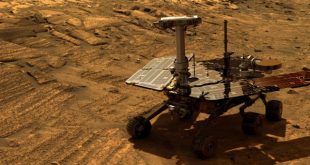
It’s common for NASA’s meticulous engineering to yield above average results. Most space missions are active much longer than the original mission parameters require. It’s not uncommon for probes and rovers to last years longer than expected, but the Opportunity rover is in a completely different league. This plucky little …
Read More »Scientists Complete Butterfly Evolutionary Tree
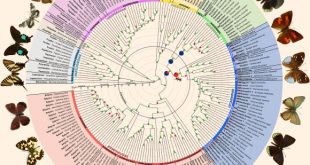
An international team of lepidopterists has compiled the most comprehensive evolutionary tree for butterflies to date. The results appear in the journal Current Biology. First comprehensive map of butterfly evolution: branch support is color coded according to the support thresholds indicated on the legend, and the shape indicates whether the …
Read More »Cheddar Man’s Face Revealed
Cheddar Man — a hunter-gatherer who lived 10,000 years ago — had blue eyes, dark colored curly hair and ‘dark to black’ skin pigmentation, according to new research. Cheddar Man’s facial reconstruction. Image credit: University College London / Natural History Museum, London / Tom Barnes / Channel 4. Cheddar Man …
Read More »Study: First Land Plants Appeared 500 Million Years Ago
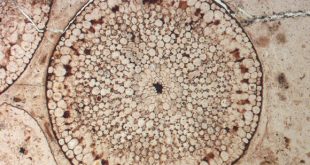
According to a new study to be published in the Proceedings of the National Academy of Sciences, the first plants to colonize the Earth originated around 500 million years ago (Cambrian period) — 100 million years earlier than previously thought. Rhynia gwynne-vaughanii, 400 million-year-old fossil plant stem from Aberdeenshire, Scotland. …
Read More »New Species of Pygmy Squid Discovered
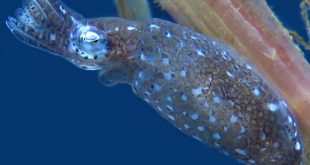
James Cook University researcher Dr. Jan Strugnell and Australian Museum Research Institute’s Dr. Mandy Reid have discovered and described a new species of pygmy squid in Australian waters. The Hallam’s pygmy squid (Idiosepius hallami), attached to a seagrass blade, Cudgen Creek, northern New South Wales. Image credit: Mandy Reid. “Although …
Read More »Glutamate Consumption Enhances Chronic Pain Symptoms, Study Says
A new pilot study, carried our in Kenya, has found a link between chronic pain and consumption of monosodium glutamate, a common flavor and taste enhancer in food. The pilot study data suggest an abnormally high prevalence of pain in Meru, Kenya, and that monosodium glutamate intake, combined with dehydration, …
Read More »Researchers Create New Kind of Photonic Matter
A team of physicists from the Massachusetts Institute of Technology (MIT) and elsewhere has created a new kind of photonic matter that could enable quantum computing with particles of light. Liang et al demonstrated that photons can be made to interact. Image credit: Christine Daniloff / MIT. Bound states of …
Read More »A Massive Vortex on Neptune Is Evaporating Before Our Eyes
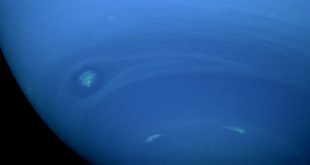
Neptune might not have the mass of Jupiter or the rings of Saturn, but it does have one distinction among planets in our solar system. Its winds are the fastest ever measured, even reaching supersonic speeds at times. Neptune’s tumultuous atmosphere gives rise to vortices similar to Jupiter’s Great Red …
Read More »
#Bizwhiznetwork.com Innovation ΛI |Technology News