The effects of long-term space travel are still murky, but it’s something we’ll need to understand if humanity is ever going to take a trip to Mars and beyond. NASA is hoping to answer some of these questions with the aid of astronaut Scott Kelly. It just so happens Scott …
Read More »Study: Women with High Cardiovascular Fitness Less Likely to Develop Dementia
According to a 44-year longitudinal population study, published online in the journal Neurology, women with high cardiovascular fitness in midlife were 88% less likely to develop dementia decades later, compared to women who were moderately fit; when the highly fit women did develop dementia, they developed the disease an average …
Read More »Humans Interbred with Denisovans Twice in History, Researchers Discover
A team of researchers from the University of Washington and Princeton University has found that the genomes of two groups of modern humans with Denisovan ancestry — individuals from Oceania and from East Asia — are uniquely different, indicating that there were two separate episodes of Denisovan admixture. Ancient hunter-gatherers. …
Read More »Dwarf Planet Ceres Continues to Evolve and Change
NASA’s Dawn spacecraft has detected recent changes in Ceres’ surface, revealing that the dwarf planet is a dynamic planetary body that continues to evolve and change. The results are published in two papers in the journal Science Advances. This false-color image shows the dwarf planet Ceres. Scientists use false color …
Read More »New Study Finds Link between Body Temperature and Obesity
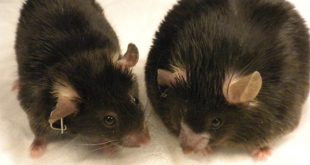
According to a study in mice published in the Journal of Neuroscience, reduced ability to maintain body temperature in colder environments may contribute to the development of obesity in adulthood. Obese and thin mice. Image credit: Shannon Reilly, University of Michigan. Energy from food fuels maintenance of a constant body …
Read More »Great Red Spot Getting Taller as It Shrinks, Planetary Scientists Say
Planetary scientists have noticed that Jupiter’s most distinctive feature — the Great Red Spot (GRS) — has been getting smaller in area over time. Because of this, many expected to see the wind speeds inside the GRS increasing as the storm was shrinking. But surprisingly, this isn’t the case — …
Read More »Physicists Solve Mystery of Why Comets Emit X-Rays
The long-standing mystery of why comets give off X-ray emission has been solved by a group of experimental physicists led by the University of Oxford, UK. On October 19, 2014, Comet Siding Spring made a remarkably close encounter with Mars, buzzing the planet at just one third of the Earth-Moon …
Read More »Kepler Spots Potentially Habitable Super-Earth Orbiting Nearby Star
Spotting new exoplanets with NASA’s Kepler space telescope is nothing new. Google even managed to automate the process with machine learning. Just add them to the pile with the 3,700 other exoplanets, right? Sometimes researchers still spot a planet of particular interest in the data that deserves additional study. Such …
Read More »Archaeopteryx Was Active Flyer, Paleontologists Say
Archaeopteryx is an iconic fossil species with feathered wings from the Late Jurassic of Germany. The question of whether this dino-bird was an elaborately feathered ground dweller, a glider, or an active flyer has fascinated paleontologists for many years. European Synchrotron Radiation Facility researcher Dennis Voeten and colleagues have now …
Read More »Scientists Identify 22 New Genetic Risk Factors for Stroke
A large-scale international collaboration called MEGASTROKE has identified 22 new genetic risk factors for stroke, thus tripling the number of gene regions known to affect stroke risk. The findings, published in the journal Nature Genetics, demonstrate shared genetic influences with multiple related vascular conditions, especially blood pressure, but also coronary …
Read More »
#Bizwhiznetwork.com Innovation ΛI |Technology News