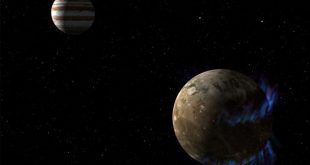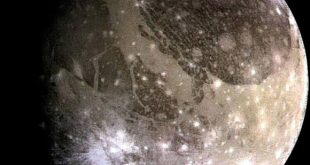
Jupiter has a whopping 69 moons, and you don’t hear a lot about the largest of them. It may not have the icy sheets of Europa or the geysers of Enceladus, but Ganymede is remarkable in its own right. In fact, it may be even more interesting than we thought. …
Read More »Researchers Find Signs of ‘Time Crystal’ in Ammonium Dihydrogen Phosphate
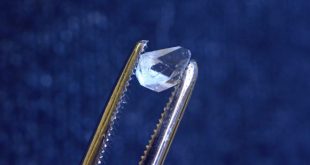
A team of physicists at Yale University has observed a signature of a discrete time crystal (DTC) in an unexpected place: a crystal of ammonium dihydrogen phosphate, better known as monoammonium phosphate (MAP). Rovny et al looked for a signature of a discrete time crystal in a crystal of monoammonium …
Read More »NASA’s InSight Mars Mission Launches Friday
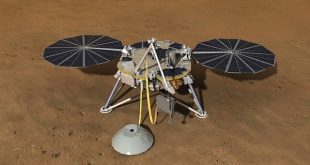
The Curiosity rover is still trundling around the red planet, and NASA’s next ambitious rover mission remains a few years away. However, the space agency has a non-wheeled Mars mission launching this very week, weather permitting. The InSight lander will delve deep into the interior of Mars, searching for clues …
Read More »Neolithic Humans Used Dried Fungi to Start and Transport Fires
Some 7,000 years ago, inhabitants of a small settlement at the Early Neolithic waterlogged site of La Draga (Girona, Spain) dried non-edible fungi for use as tinder to light and transport fires. An artist’s impression of prehistoric humans in Europe. The La Draga site is located on the eastern shore …
Read More »Five Healthy Lifestyle Habits Can Extend Life by 12-14 Years
Living a healthy lifestyle — eating a healthy diet, exercising regularly, keeping a healthy body weight, not drinking too much alcohol, and not smoking — during adulthood may extend longevity by 14 years for women and 12 years for men, according to a new study published in the journal Circulation. …
Read More »NASA Reveals New Results from Galileo’s Historic Flyby of Jupiter’s Moon Ganymede
On June 27, 1996, NASA’s Galileo spacecraft made humanity’s first flyby of Ganymede, Jupiter’s largest moon, discovering that it is the only moon known to possess an internally generated magnetic field. As at Earth, Ganymede’s magnetic field projects a magnetic bubble around it called a magnetosphere. Galileo carried a package …
Read More »New Report Suggests Mercury’s Crust Is Thinner, Denser Than Thought
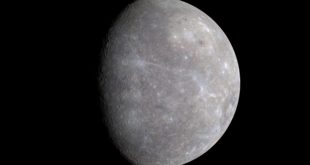
Researcher and scientist Michael Sori believes the crust of Mercury may be thinner and denser than previously estimated. If the finding is true, it would make the already-odd Mercury a bit more strange. Mercury orbits in a unique 3:2 spin-orbit resonance, in which the planet rotates on its axis exactly …
Read More »Physicists Entangle Two Macroscopic-Scale Objects
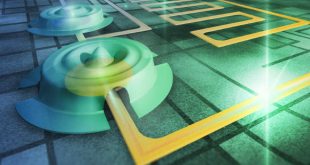
Entanglement — an intriguing phenomenon in which two distant objects can manifest correlations, even if they are far away from each other — has now been made a reality in macroscopic-scale objects. An illustration of tiny drumheads prepared on silicon chips used in the experiment; the drumheads vibrate at a …
Read More »Stephen Hawking’s 5 Greatest Achievements
When Stephen Hawking died in March, we couldn’t stop reading and watching tributes. His public roles as researcher, speaker, writer, and advocate over the years have endeared this man to generations of people around the world. So in honor of this scientific giant, we’ve put together a list of his …
Read More »Gaia Spacecraft Creates Map of More Than 1 Billion Stars in Our Galaxy
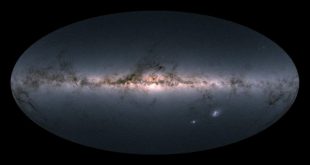
The ESA’s Gaia spacecraft has already been studying the Milky Way galaxy for several years, and the first release of data included the precise location of more than 2 million stars. Now, the second major dataset from Gaia has pinpointed the position and brightness of 1.7 billion stars in our …
Read More »
#Bizwhiznetwork.com Innovation ΛI |Technology News