November 8, 2020
Space Exploration
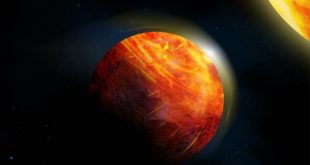
You could argue that Earth hasn’t been an ideal place to live lately, but it could be worse. Scientists from Canada’s McGill University have released a new analysis of an exoplanet called K2-141b. This world orbits its star so closely that its ecosystem is profoundly hellish. The ground is …
Read More »
November 4, 2020
Space Exploration
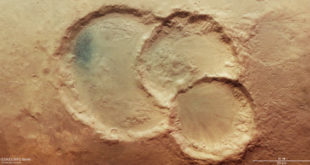
ESA’s Mars Express orbiter has spotted three overlapping craters in Noachis Terra, an extensive landmass in the southern hemisphere of Mars. This image shows a triple crater in Noachis Terra, Mars. The largest crater measures 45 km across, and the smallest 28 km. There are also signs of other sizeable …
Read More »
October 31, 2020
Space Exploration
Astronomers have identified more than 4,000 exoplanets orbiting other stars but just a few “rogue planets” wandering the galaxy without a star to call home. A new study claims to have spotted one of these worlds, and it may be a small, rocky world like Earth. If confirmed, the …
Read More »
September 27, 2020
Space Exploration
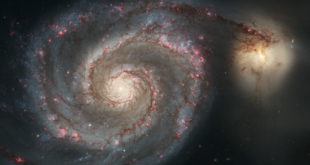
Humanity spent years wondering if there were planets outside our solar system, and now we know the answer: very much yes. There are thousands of exoplanets in just our little corner of the galaxy, and there’s every reason to expect the same is true of other galaxies. In fact, …
Read More »
September 23, 2020
Space Exploration
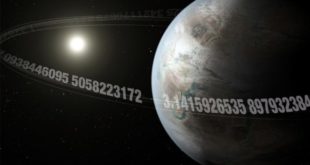
With 3.14-Day Orbit The longer we study the universe, the more exoplanets we find. Many of these discoveries are notable because of how Earth-like they are or because of the number of planets crammed into a single solar system. The rocky planet K2-315b, on the other hand, is notable because …
Read More »
September 21, 2020
Space Exploration
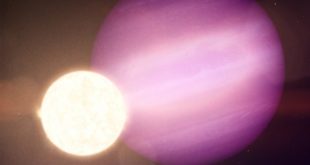
Humanity has identified thousands of exoplanets, so you’d think we’ve got a pretty good handle on where to look for them. And yet, the universe keeps surprising us. A new study led by Andrew Vanderburg of the University of Wisconsin-Madison reveals a possible exoplanet some 80 light-years away. The …
Read More »
August 12, 2020
Space Exploration
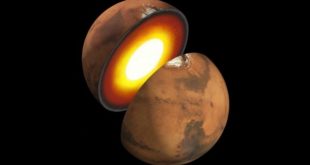
NASA’s InSight Mars Lander Reveals Scientists believe Mars was much more similar to Earth in the distant past, not the dried-up ball of dust it is today. Understanding Mars could help us better understand how planets form, and the NASA InSight mission has the tools to get us there. Using …
Read More »
August 12, 2020
Space Exploration
High-resolution observations from NASA’s Dawn spacecraft of mysterious bright spots (faculae) in Occator crater on the dwarf planet Ceres suggest the existence of a brine reservoir — which is about 40 km (25 miles) deep and hundreds of km wide — that emerged to the surface through long-lived cryovolcanic activity …
Read More »
July 16, 2020
Space Exploration
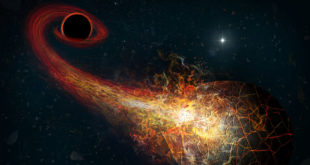
‘Planet Nine’ Might Be an Ancient Black Hole We tend to think of the solar system as our little corner of the universe, but there are still a lot of things we don’t know about it. For example, what’s perturbing the orbits of small space rocks out past the orbit …
Read More »
June 3, 2020
Space Exploration
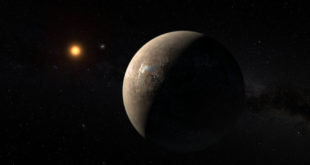
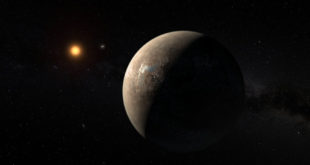
Astronomers Confirm Earth-Like Planet Orbiting Nearest Star Scientists used to wonder if planets were common throughout the universe, and now we know: they are. Observations with ground-based and space telescopes like Kepler and TESS have proven planets are extremely common. There’s even a small, Earth-like planet right next door orbiting …
Read More »
 #Bizwhiznetwork.com Innovation ΛI |Technology News