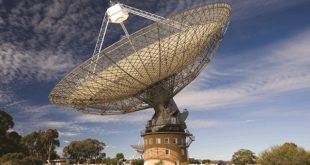
Humanity has made significant progress understanding the cosmos in recent decades thanks to amazing instruments like the Hubble Space Telescope. There are still some phenomena that defy explanation, though. For example, fast radio bursts. Astronomers only noticed these mysterious signals in 2007, and their unpredictable nature makes it difficult to …
Read More »SpaceX Is Building Its BFR in Los Angeles, and Congress May Not Be Happy
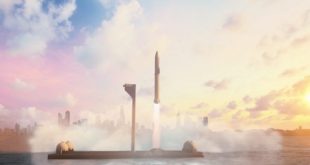
As SpaceX ramps up rocket production and rehabilitation, it’s going to need new facilities. That can be tricky for any company, but it’s a particularly difficult problem when you need to build enormous rockets suitable for interplanetary missions with large payload fairings like SpaceX’s upcoming BFR (Big Falcon Rocket). SpaceX …
Read More »TRAPPIST-1 Exoplanets May Have Too Much Water for Life
The TRAPPIST-1 system seems at first to be a good place to look for extraterrestrial life. It has seven rocky planets roughly the same size as Earth, and some of them are in the “habitable zone” of the star where liquid water could exist on the surface. Now, researchers from …
Read More »Martian Oceans Formed Earlier than Thought, Geophysicists Say
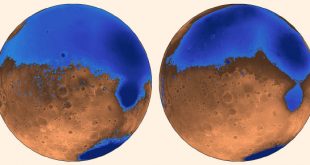
A team of geophysicists at the University of California, Berkeley, proposes that Martian oceans originated several hundred million years earlier than thought, as the Solar System’s largest volcanic system — called Tharsis — formed, and that greenhouse gases enabled the oceans. The team’s theory predicts smaller oceans, more in line …
Read More »Kepler Spacecraft Will Run Out of Fuel In the Coming Months
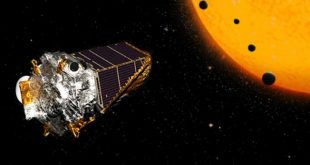
The Kepler Space Telescope has discovered more than 2,000 exoplanets in our galaxy, exceeding all expectations for the mission. Even after tragic setbacks, this plucky little space telescope has been a boon to science. Yet, it’s days are numbered, according to NASA. Mission managers say they expect Kepler to run …
Read More »Astronaut’s Gene Expression May Be Permanently Changed by Year in Space
The effects of long-term space travel are still murky, but it’s something we’ll need to understand if humanity is ever going to take a trip to Mars and beyond. NASA is hoping to answer some of these questions with the aid of astronaut Scott Kelly. It just so happens Scott …
Read More »Dwarf Planet Ceres Continues to Evolve and Change
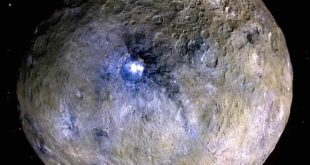
NASA’s Dawn spacecraft has detected recent changes in Ceres’ surface, revealing that the dwarf planet is a dynamic planetary body that continues to evolve and change. The results are published in two papers in the journal Science Advances. This false-color image shows the dwarf planet Ceres. Scientists use false color …
Read More »Great Red Spot Getting Taller as It Shrinks, Planetary Scientists Say
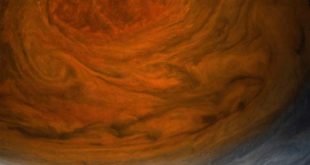
Planetary scientists have noticed that Jupiter’s most distinctive feature — the Great Red Spot (GRS) — has been getting smaller in area over time. Because of this, many expected to see the wind speeds inside the GRS increasing as the storm was shrinking. But surprisingly, this isn’t the case — …
Read More »Physicists Solve Mystery of Why Comets Emit X-Rays
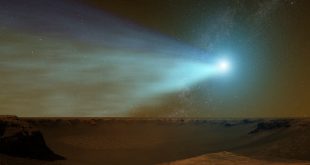
The long-standing mystery of why comets give off X-ray emission has been solved by a group of experimental physicists led by the University of Oxford, UK. On October 19, 2014, Comet Siding Spring made a remarkably close encounter with Mars, buzzing the planet at just one third of the Earth-Moon …
Read More »Kepler Spots Potentially Habitable Super-Earth Orbiting Nearby Star
Spotting new exoplanets with NASA’s Kepler space telescope is nothing new. Google even managed to automate the process with machine learning. Just add them to the pile with the 3,700 other exoplanets, right? Sometimes researchers still spot a planet of particular interest in the data that deserves additional study. Such …
Read More »
#Bizwhiznetwork.com Innovation ΛI |Technology News